
Pimobendan (Vetmedin) for Dogs: What It Does and Which Dogs It Is For
By Sarah Bennett · Last updated September 27, 2026 · 11 min read
Pimobendan for dogs is unusual in two directions at once. It is one of the few heart medications a vet will start before a dog has any symptoms, and it is one of the few that the label says outright must not be given at certain stages. Both of those come from the same place: the FDA-approved label for Vetmedin, which is written around the same staging system your vet uses. So the useful question is not whether the drug works, because two large trials answered that, but whether your dog is at the stage where it is indicated.
This page takes the label's own wording as the spine, adds what the trials measured in time, and includes the side-effect table from the manufacturer's field study with both arms, because a list showing only the treated dogs turns the disease's own symptoms into drug effects.
What Pimobendan Is Approved For
The FDA-approved Vetmedin label states its two indications directly. The first is prevention of the next stage: it is "indicated for the delay of onset of congestive heart failure in dogs with Stage B2 preclinical myxomatous mitral valve disease." The second is treatment once failure has happened: it is "indicated for the management of the signs of mild, moderate, or severe congestive heart failure (CHF) in dogs due to clinical MMVD or dilated cardiomyopathy (DCM)."
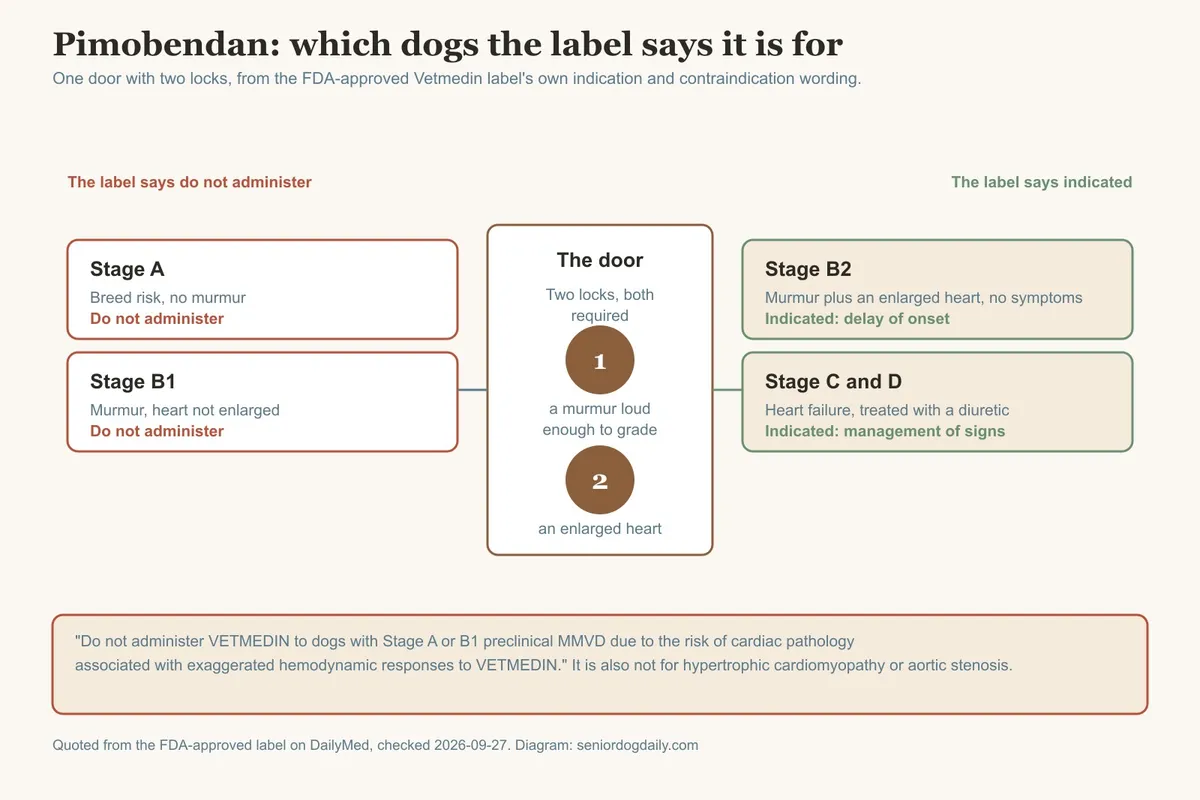
The same label defines that B2 group, and the definition is the doorway to the drug: "Stage B2 preclinical myxomatous mitral valve disease (MMVD) refers to dogs with asymptomatic MMVD that have a moderate or loud mitral murmur due to mitral regurgitation and cardiomegaly." Two components, then: a murmur loud enough to be graded, and cardiomegaly, meaning a heart that has actually enlarged on imaging. A murmur alone is not the entry condition.
That matches the staging our heart murmur in senior dogs page covers from the other direction. The ACVIM panel sets the same bar in numbers, and the label's plain-language version and the panel's four criteria describe one door with two locks.
The label also states the drug is "indicated for use with concurrent therapy for congestive heart failure (e.g., furosemide, etc.) as appropriate on a case-by-case basis", which is the part owners meet first: it usually comes home alongside a diuretic rather than instead of one. Our furosemide for dogs page covers that partner drug.
What It Actually Does
The label describes the mechanism in one sentence: pimobendan works by a "dual mechanism of action consisting of an increase in calcium sensitivity of cardiac myofilaments and inhibition of phosphodiesterase (Type III)." In plain terms it does two jobs at once. It makes each heartbeat squeeze a little more effectively, and it opens the blood vessels so the heart is pushing against less resistance. Neither effect addresses the leaking valve itself; what they do is let the same damaged heart move blood more efficiently, which is why the drug buys time rather than repairing anything.
That distinction matters for expectations. Pimobendan does not stop mitral valve disease. It changes how long the heart can compensate for it.
Which Dogs It Is For, and Which It Is Not
The label draws the exclusion as sharply as the indication. It states: "Do not administer VETMEDIN to dogs with Stage A or B1 preclinical MMVD due to the risk of cardiac pathology associated with exaggerated hemodynamic responses to VETMEDIN."
Read together with the indication, that gives the whole map. A dog at Stage A has a breed risk and no murmur. A dog at B1 has a murmur but a heart that has not enlarged enough to qualify. Neither should be on this drug, and the reason given is not cost or caution but a specific risk of harm. The label lists two other situations where it must not be used: "Do not administer VETMEDIN in cases of hypertrophic cardiomyopathy, aortic stenosis, or any other clinical condition where an augmentation of cardiac output is inappropriate for functional or anatomical reasons." Those are different diseases with different mechanics, and a drug that increases cardiac output is the wrong tool in them.
So if you have a senior dog with a newly heard murmur, the honest sequence is: the murmur is the reason to look further, the echocardiogram is what shows whether the heart has enlarged, and the enlargement is what puts pimobendan on the table. Our stages and life expectancy page lays out what each stage means afterward.
What the Trials Measured
Two trials are why this drug is started early, and both are quoted here as published.
In dogs with an enlarged heart but no symptoms (B2), the EPIC trial reported that "Median time to primary endpoint was 1228 days (95% CI: 856–NA) in the pimobendan group and 766 days (95% CI: 667–875) in the placebo group". The authors summarized the meaning of that gap themselves: "Prolongation of preclinical period by approximately 15 months represents substantial clinical benefit."
In dogs already in heart failure (Stage C), the QUEST study compared pimobendan against benazepril and reported that "One hundred and ninety dogs reached the primary endpoint; the median time was 188 days (267 days for pimobendan, 140 days for benazepril hazard ratio = 0.688, 95% confidence limits [CL]=0.516-0.916, P= .0099)."
The two trials measured different things in different populations: EPIC counted time to the first episode of heart failure or cardiac death in dogs who had not yet had one, while QUEST counted time to a composite of cardiac death, euthanasia for heart failure, or treatment failure in dogs who were already in failure. Neither promises a normal lifespan. What they establish is that the drug changed the measured outcome in its favor in both populations, and that the earlier population is the one the label approves it for.
What the Label's Own Data Shows About Side Effects
The label reports a field study of 363 dogs with Stage B2 disease, 182 given the drug and 181 given a control chew, followed until heart failure, death, or up to three years. Because both groups were dogs with the same disease, the table is unusually informative:
| Finding | Pimobendan (n=182) | Control (n=181) |
|---|---|---|
| Cough | 21.4% | 23.2% |
| Lethargy | 8.8% | 7.2% |
| Reduced appetite | 7.7% | 7.2% |
| Fast or labored breathing | 7.1% | 6.6% |
| Arrhythmia | 3.9% | 1.7% |
| Collapse | 2.2% | 1.1% |
| Dyspnea | 2.2% | 1.7% |
| Fainting | 0.0% | 2.8% |
The label's own summary of the most common finding is that "Cough was the most frequently reported adverse reaction in this study. This clinical finding is commonly reported in cases of MMVD, and the incidence was similar between treatment groups." What that means for an owner is that a cough appearing after the drug starts is at least as likely to be the disease as the pill. The one line worth asking the vet about is the arrhythmia figure, the only finding meaningfully higher in the treated group, though the numbers are small enough that a few dogs either way would move it.
The same label reports that "Mortality rate, regardless of reason, prior to CHF was similar between the VETMEDIN and the control groups." The drug's measured benefit in that study was in delaying heart failure, not in preventing death from other causes in a group of old dogs.
For the non-cardiac side effects the label names gastrointestinal upset, vomiting and diarrhea, as the most frequent, which is the one that shows up in practice as a dog who is a bit off his food in the first week.
What It Costs Over Time
Pimobendan is a daily medication for the rest of the dog's life, and the ACVIM panel is blunt about why that matters at the moment of starting: "Ideally, all these criteria should be met before initiating treatment, because treatment represents a lifelong commitment."
The label lists the tablets in four strengths, and the dose is set by the vet against the dog's weight, so the monthly cost depends on the dog and on the pharmacy. The price is stable month to month and can be checked before starting, which makes it worth pricing out across a year rather than a month. This page does not print a figure, because a price published here is out of date the week after it is written.
If the arithmetic is the thing deciding it for you, the same framework in our is pet insurance worth it for a senior dog page applies to a drug like this one: a known monthly cost against an uncertain future, made at a point when the dog is still well.
The Number to Watch Once She Is On It
Whatever else changes, the measurement that guides this drug and its partner diuretic is the same one: her sleeping breathing rate. A rate that starts climbing while she is on treatment is what prompts a dose change or an added medication, and it does so before a cough or a bad night.
The 2019 ACVIM guidelines put that measure above the alternatives, and our free resting breathing rate counter times it and keeps the readings. Counting is easy to start and hard to sustain through a year of ordinary nights; if it slips, a collar sensor can carry it. Maven Pet logs resting respiratory rate and heart rate overnight and flags a rising trend, which is the signal a dose change is decided on. It does not diagnose anything and it does not replace the recheck. Our Maven Pet review covers what it measures and what it does not. Maven is an affiliate partner; if you subscribe through that link we may earn a commission at no extra cost to you.
Frequently Asked Questions
What does pimobendan do for a dog with heart disease?
It increases the force of each heartbeat and widens the blood vessels, so a heart with a leaking valve moves blood more efficiently. It does not repair the valve. In dogs with an enlarged heart and no symptoms, the trial's endpoint was the time until heart failure or cardiac death, and the treated group reached it later. In dogs already in failure, the endpoint was a composite of cardiac death, euthanasia for heart failure or treatment failure, and the treated group reached that later too.
Is Vetmedin the same as pimobendan?
Yes. Vetmedin is the brand name of the FDA-approved pimobendan product, and the label quoted on this page is that product's. Other companies also market pimobendan tablets, so the terms worth checking are the ones printed for the specific product your dog is prescribed rather than the brand name alone.
Can a dog with a heart murmur start pimobendan straight away?
Not on the label's terms. The indication is for Stage B2, which the label defines as asymptomatic disease with a moderate or loud murmur and cardiomegaly, meaning the heart has actually enlarged. The same label states that it must not be given to dogs at Stage A or B1. The echocardiogram is what separates the stages.
What side effects should I watch for in the first weeks?
The label's most common non-cardiac finding is gastrointestinal upset, meaning vomiting and diarrhea. Coughs appear in both treated and untreated dogs with this disease at nearly identical rates, so a new cough is a question for the vet rather than a settled side effect, and the treated group showed a slightly higher rate of arrhythmia in the field study.
Sources
- Boehringer Ingelheim Animal Health. VETMEDIN (pimobendan) Chewable Tablets, FDA-approved label. DailyMed, U.S. National Library of Medicine. Source of both indications, the Stage B2 definition, the stage and disease contraindications, the mechanism statement, the field-study adverse reaction table and its commentary, and the mortality statement. Checked 2026-09-27. dailymed.nlm.nih.gov
- Boswood A, Häggström J, Gordon SG, et al. Effect of Pimobendan in Dogs with Preclinical Myxomatous Mitral Valve Disease and Cardiomegaly: The EPIC Study. Journal of Veterinary Internal Medicine, 2016. Checked 2026-09-27. pmc.ncbi.nlm.nih.gov
- Häggström J, Boswood A, O'Grady M, et al. Effect of pimobendan or benazepril hydrochloride on survival times in dogs with congestive heart failure caused by naturally occurring myxomatous mitral valve disease: the QUEST study. Journal of Veterinary Internal Medicine, 2008. Checked 2026-09-27. pubmed.ncbi.nlm.nih.gov
- Keene BW, Atkins CE, Bonagura JD, et al. ACVIM consensus guidelines for the diagnosis and treatment of myxomatous mitral valve disease in dogs. Journal of Veterinary Internal Medicine, 2019. Source of the lifelong-commitment statement and the resting respiratory rate statement. Checked 2026-09-27. pmc.ncbi.nlm.nih.gov
Keep Reading
- Congestive heart failure stages and life expectancy, where this drug sits in each stage
- Furosemide for dogs with heart failure, the drug it is usually given with
- Heart murmur in senior dogs, the grading that leads to the echocardiogram
- Resting breathing rate counter, the number that guides the dose
If she has an enlarged heart and no symptoms yet, ask the vet one question directly: does she meet the Stage B2 criteria today? The answer is what starts or delays this drug.
About the authors
Sarah Bennett researches senior dog care from a home centered on her Border Collie, Lucy. I am not a veterinarian; the indications, contraindications, mechanism and side-effect figures on this page are quoted from the FDA-approved label and the two trials, each linked at the claim, and no dose on this page is a recommendation.
Leo Bennett handles the reading and fact-checking behind these pieces, including checking that the trial medians quoted here match the wording on our heart failure page, since the same figure stated two ways across two pages is how a site starts to look unreliable.
Sarah and Leo Bennett are pen names. Senior Dog Daily is written and checked by a small editorial team; see About.