
Heart Murmur in Senior Dogs: What the Grade Means and What Happens Next
By Sarah Bennett · Last updated September 22, 2026 · 10 min read
Your vet heard turbulence where blood should be flowing smoothly, gave it a number out of six, and that number is where most owners start searching. A heart murmur in senior dogs is a sound, not a diagnosis, and the number measures how loud the sound is, which is related to how sick your dog is in some cases and not in others. This page explains which case is which. It also covers what the grades mean, what usually causes a murmur in an older dog, and what the vet does with the finding.
What the Grades I to VI Measure
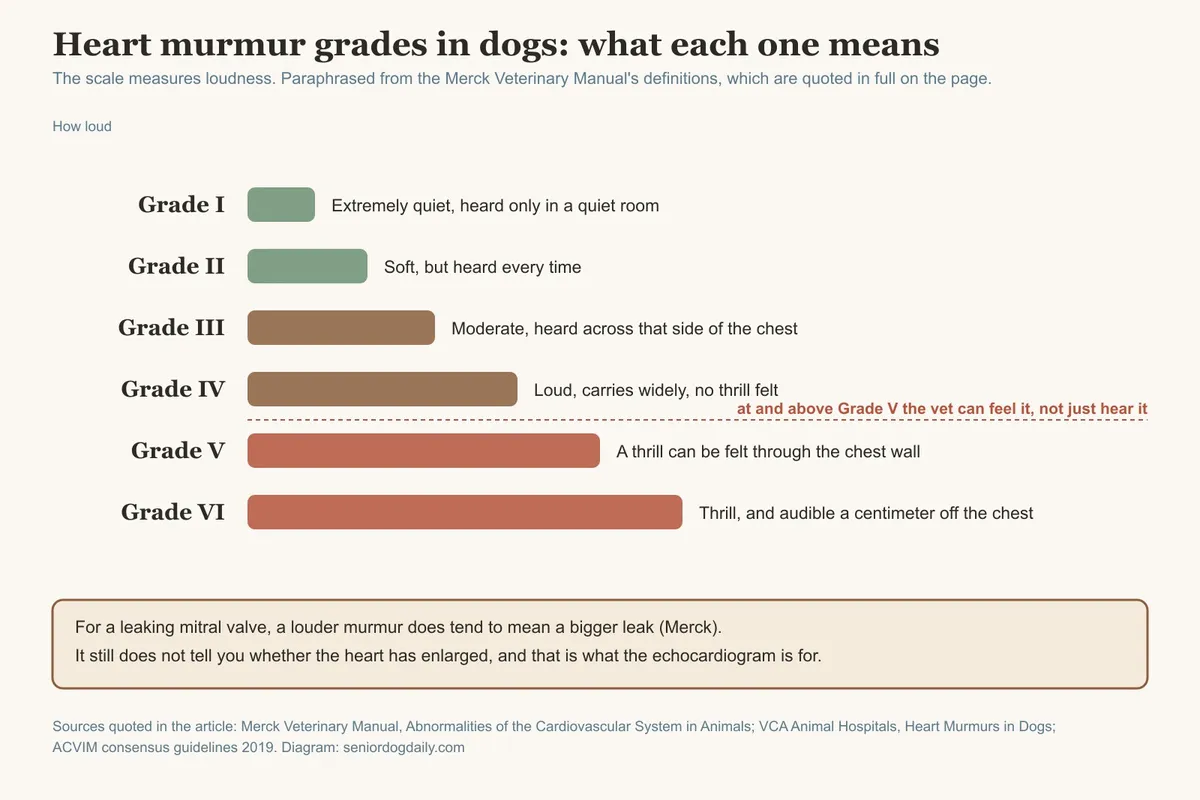
Vets grade murmurs on a six-point scale by how loud they are. VCA's client information on heart murmurs describes the scale and its two ends: "Murmurs are graded by their intensity, usually on a scale of I-VI." At the quiet end, "A Grade I murmur is very soft or quiet, may only be heard intermittently, and is usually only heard in one location on the chest, while a Grade VI murmur is very loud, heard everywhere that the heart can be heard, and can be felt when a person places their hand on the chest in the area of the heart."
The Merck Veterinary Manual sets out what each grade means to the person holding the stethoscope, and the dividing line that matters is the thrill, a vibration the vet can feel through the chest wall with a hand.
| Grade | The Merck Veterinary Manual's definition |
|---|---|
| I | "extremely quiet, focal, and only heard in a quiet environment" |
| II | "soft, focal, although consistently auscultated" |
| III | "consistent, moderate intensity, and regional (heard throughout the hemithorax)" |
| IV | "consistent, loud, radiating widely WITHOUT a palpable precordial (chest wall covering the heart) thrill" |
| V | "consistent, widely radiating WITH a palpable precordial thrill (vibration felt in the chest wall over the heart) present" |
| VI | "consistent, loud, widely radiating WITH palpable precordial thrill, and audible with the stethoscope when lifted 1 cm away from the surface of the thorax" |
Two practical readings of that table. A murmur only heard in a quiet room is a I, and vets differ on the quiet end, so a dog can be a I at one clinic and a II at the next without anything having changed. And the jump from IV to V is not about loudness; it is the point at which the turbulence becomes strong enough to feel.
Does a Louder Murmur Mean Worse Disease?
Sources aimed at owners and sources aimed at vets answer this differently, and the difference is worth understanding rather than picking a side.
The owner-facing version, from VCA, is a caution: "the loudness of a heart murmur does not always correlate directly with the severity of the disease." What the loudness reflects is physics, since "The loudness of a murmur reflects the amount of turbulence that is present in the heart."
The clinical version is more specific. The Merck Veterinary Manual states that "The intensity of the heart murmur correlates with the severity of disease in dogs and other species specifically with MMVD, as the intensity of the left apical systolic murmur correlates well with the degree of mitral regurgitation (volume of leak at the valve)." And then it draws the boundary: "This does not hold true in the face of systolic dysfunction or for myocardial disease such as DCM in dogs."
Put together, and this is our reading rather than either source's: if your senior dog's murmur comes from a leaking mitral valve, which is the usual cause, a louder murmur does tend to mean a bigger leak. That is not the same as knowing how enlarged her heart is, how close she is to heart failure, or how long she has, and those are the questions owners actually mean when they ask what the grade means. A big leak that the heart has absorbed without enlarging is a different situation from a smaller leak in a heart that has already stretched, and no stethoscope separates them. If the murmur comes from heart muscle disease rather than a valve, the loudness stops tracking severity altogether.
So the grade is real information, not a formality, and it is also the first line of a longer report.
What Usually Causes a Murmur in an Older Dog
In a dog who has been healthy for years and suddenly has a murmur at eight or ten, one cause dominates. According to VCA, "The most common cause of an acquired heart murmur in the dog is mitral insufficiency (also called mitral regurgitation), a condition in which the mitral valve becomes thickened and begins leaking". That is the disease behind most senior heart failure, and the reason the rest of this cluster exists; our heart disease in senior dogs page covers what it does over time.
Two other cardiac causes turn up in older dogs, and the same page names them: "Other causes of an acquired heart murmur in older dogs include bacterial endocarditis caused by a bacterial infection that localizes on a heart valve and dilated cardiomyopathy (DCM)."
And then there is the group worth knowing about before you assume the worst, because some of these resolve when the underlying problem is treated. VCA calls these functional murmurs: "A functional heart murmur may be due to anemia (low levels of red blood cells), hypoproteinemia (low protein levels in the blood), fever or infection, pregnancy, obesity, or emaciation." An anemic senior dog can have a murmur that fades as the anemia is corrected, which is one reason the vet may run bloodwork before reaching for a cardiac workup.
Why the Vet Wants an Echocardiogram
The stethoscope finds the murmur; the ultrasound decides what it means. The 2019 ACVIM consensus guidelines on mitral valve disease are direct about why: "Echocardiography, performed by an experienced operator, is recommended to definitively identify the cause of the murmur, answer specific questions regarding the severity of cardiac chamber enlargement, and identify comorbidities."
Three things come out of that scan that the grade cannot give you: which valve is leaking and how badly, whether the heart has enlarged, and whether anything else is going on. The middle one is the one that changes what happens next, because enlargement is what treatment is aimed at.
Why "3 out of 6" Keeps Showing Up in the Notes
If your dog's record says 3/6 and the vet talked about starting a drug or waiting, that number is doing specific work. It is one of four criteria the ACVIM panel uses to identify the dogs who benefit from treatment before any symptoms appear, the group they call Stage B2. The guidelines list them together: "murmur intensity ≥3/6"; "echocardiographic LA : Ao ratio in the right‐sided short axis view in early diastole ≥1.6"; "Left ventricular internal diameter in diastole, normalized for body weight (LVIDDN) ≥1.7"; and a breed-adjusted "radiographic vertebral heart score (VHS) >10.5".
The murmur grade is the cheapest of the four and the only one you can get with a stethoscope, which is why it is the one that reaches the owner. The other three come from an ultrasound and an X-ray, and they are the ones that carry the decision. The panel asks for all four, not one: "Ideally, all these criteria should be met before initiating treatment, because treatment represents a lifelong commitment."
That sentence answers the question owners usually ask next. Hearing 3/6 does not mean your dog starts medication today. It means she has cleared the first of four gates, and the scan decides the rest. What each stage means for time is on our congestive heart failure stages and life expectancy page.
If Your Dog Is a Small Breed, This Is a Yearly Question
Mitral valve disease is overwhelmingly a small-dog disease, and the guidelines ask for yearly listening rather than waiting for a symptom. The ACVIM panel writes: "Small breed dogs, including breeds with known predisposition to develop MMVD (eg, Cavalier King Charles Spaniels, Dachshunds, Miniature, and Toy Poodles) should undergo regular evaluations (yearly auscultation by the family veterinarian) as part of routine health care."
If you have a Cavalier, our senior Cavalier King Charles Spaniel health problems page covers why this breed carries the heaviest version of it. For everyone else, the practical version is that the murmur check is part of the senior wellness exam, and it is the reason those visits are worth keeping even when nothing seems wrong.
What to Do at Home After a Murmur Is Found
For a dog with a murmur and no symptoms, there is usually nothing to treat and one thing to track: her sleeping breathing rate. It is the measure that catches fluid backing into the lungs before a cough starts, and the ACVIM guidelines rate it above the alternatives: "Of these variables, identification of increases in resting respiratory rate above normal baseline has the best predictive value for impending clinical decompensation."
Start now, while she is well, because the number that matters is her own baseline rather than any published threshold. Count her breaths for 30 seconds while she sleeps, double it, and write it down a few times a week; our resting breathing rate counter does the timing and keeps the readings. A year of quiet numbers is not wasted effort, it is the thing that makes a rising number mean something.
Also worth mentioning to the vet, since owners often do not connect them to the heart: a cough that shows up at rest or at night, tiring on walks she used to manage, panting that does not settle, or a faint or collapse during excitement.
Frequently Asked Questions
Does a heart murmur mean my dog has heart failure?
No. A murmur means turbulent flow, and in a senior dog it most often means a leaking mitral valve. Heart failure is a later stage of that disease, defined by fluid backing up into the lungs or abdomen, and many dogs with murmurs never reach it. The stage, not the grade, is what predicts that.
Can a heart murmur go away in a dog?
A functional murmur can. VCA lists anemia, low blood protein, fever or infection, pregnancy, obesity and emaciation as causes of functional murmurs, and correcting the underlying problem can resolve the sound. A murmur from a degenerating mitral valve does not go away, because the valve does not repair itself.
How long can a dog live with a grade 3 heart murmur?
The grade is the wrong number for that question. Survival in mitral valve disease tracks the stage, which depends mainly on how enlarged the heart is, and published median survival ranges from years in dogs found before symptoms to months once heart failure has occurred. Our stages and life expectancy page has the figures by stage.
Is a grade 5 murmur worse than a grade 3?
In the sense the scale measures, yes: a Grade V is loud enough that the vet can feel the vibration through the chest wall, which a Grade III is not. In the sense you mean, it depends on the cause. For a leaking mitral valve, a louder murmur does tend to mean a larger leak; for heart muscle disease it does not track at all. The scan is still what decides.
Is anesthesia safe for a dog with a heart murmur?
It depends on what is behind the murmur, which is exactly why vets want the echocardiogram before an elective procedure rather than after. A murmur is a reason to work it up and plan, not an automatic refusal; our page on anesthesia in senior dogs covers how that risk is actually assessed.
Sources
- VCA Animal Hospitals. Heart Murmurs in Dogs. Source of the owner-facing loudness statement, the turbulence statement, and the acquired and functional causes. Checked 2026-09-22. vcahospitals.com
- Abnormalities of the Cardiovascular System in Animals. Merck Veterinary Manual. Source of the six grade definitions and of the statement that intensity tracks severity in MMVD but not in myocardial disease. Checked 2026-09-22. merckvetmanual.com
- Keene BW, Atkins CE, Bonagura JD, et al. ACVIM consensus guidelines for the diagnosis and treatment of myxomatous mitral valve disease in dogs. Journal of Veterinary Internal Medicine, 2019. Source of the echocardiography recommendation, the four Stage B2 criteria, the lifelong-commitment statement, the yearly auscultation recommendation for small breeds, and the resting respiratory rate statement. Checked 2026-09-22. pmc.ncbi.nlm.nih.gov
Keep Reading
- Congestive heart failure stages and life expectancy, what happens after the scan
- Heart disease in senior dogs, the cough and the home test
- Resting breathing rate counter, the number to start tracking today
- Senior Cavalier King Charles Spaniel health problems, the breed this hits hardest
Somewhere tonight she is asleep on her side, breathing at the rate she has always breathed, with no idea that a number followed her home from the exam. Most of what comes next is decided in a room with an ultrasound machine in it, by people who do this all day. The breathing count is the part that belongs to you.
About the authors
Sarah Bennett researches senior dog care from a home centered on her Border Collie, Lucy. I am not a veterinarian; the grading scale is quoted from the Merck Veterinary Manual and the causes from VCA's client information, and the criteria and recommendations are the ACVIM panel's own words, each linked at the claim.
Leo Bennett handles the reading and fact-checking behind these pieces, including confirming that the four Stage B2 thresholds are quoted as the guidelines print them, since three of the four come from imaging rather than from the stethoscope.
Sarah and Leo Bennett are pen names. Senior Dog Daily is written and checked by a small editorial team; see About.