
Is Pet Insurance Worth It for a Senior Dog?
By Sarah Bennett · Last updated September 26, 2026 · 9 min read
Whether pet insurance is worth it for a senior dog turns on one thing that surprises most owners: a policy pays for conditions that begin after it starts, not the ones she already has. So the question is not "will she need expensive care", because she probably will. It is whether the next expensive thing will be a new diagnosis or the same one she is already carrying, and only one of those is insurable. That single split decides the answer, and it is why two owners with two twelve-year-old Labradors can get opposite advice and both be right.
This page splits the question into the half you can answer today and the half nobody can, then shows the arithmetic that connects them. It does not name a policy or a price, because no provider prices a dog without her breed, age and postcode, and every figure published in an article like this one is out of date the week after it is written.
| The ordinary question | What actually decides it |
|---|---|
| Will she need expensive care? | Whether the next expensive thing is a new diagnosis or one she already has |
| What do policies cost on average? | Your own quote, after the five written answers below |
| Is an old dog covered? | A new policy pays for what begins after it starts |
The Half Nobody Can Answer in Advance
Two numbers decide whether insurance pays off for your dog, and neither is knowable when you buy.
The first is whether something new and expensive happens. No article can settle that for your dog, which is why the second number matters more.
The second is whether the policy would actually pay. A dog who already has arthritis, a heart murmur, dental disease or an eye change has almost all of that excluded, so the policy is not covering the dog you have today. It is covering a dog who may or may not develop something else. For a fifteen-year-old dog with several diagnoses, what a new policy covers is the next thing and not the current list.
Where that leaves the decision: you would be paying now for something that may not happen, while the conditions already written in her record sit outside what a new policy covers. That is ordinary insurance math rather than a bad deal in itself. It becomes a poor one when the premium is high, the exclusions are broad, and her remaining years are few.
The Half You Can Answer Today
The contract is the part you can read today, and it is not optional for the insurer to tell you what it excludes. In states that have adopted the pet insurance model act, that is written into law. New Hampshire's chapter on pet insurance requires that "A pet insurer transacting pet insurance shall disclose the following to consumers: (a) If the policy excludes coverage due to any of the following: (1) A preexisting condition; (2) A hereditary disorder; (3) A congenital anomaly or disorder; or (4) A chronic condition".
Five things to get in writing before you pay anything, in the order they change the answer:
- The definition of pre-existing. Look for whether a symptom in the record counts, or only a diagnosis. The difference decides whether the limp you mentioned at last year's exam is excluded forever.
- Whether a resolved condition can become coverable. Some insurers describe a symptom-free period after which a curable condition can be insured; others treat every past condition as permanent.
- The waiting periods, by condition type. A condition that appears in week three of a policy with a longer waiting period is a claim that gets refused.
- Whether the premium can go up because she is getting older. The same statute requires the insurer to disclose "Whether the pet insurer reduces coverage or increases premiums based on the insured's claim history, the age of the covered pet, or a change in the geographic location of the insured", so this is a question with a written answer rather than a guess.
- The enrollment age rule. At least one insurer writes an age cutoff on its own page. This page does not restate that wording, because a shortened version can turn an enrollment limit into a coverage limit. Whether the others have an equivalent rule is worth asking rather than assuming, and our guide to what each provider says about enrolling an older dog keeps the verified wording with links to each page.
Those five answers are the whole game for an older dog. Everything else, including price, is secondary to whether the policy would pay for the thing that is most likely to happen.
One more piece of the law that owners rarely hear about, from the same section: unless a claim has already been filed, the applicant "shall have the right to examine and return the policy, certificate, or rider to the company or an agent/insurance producer of the company within 30 days of its receipt and to have the premium refunded if, after examination of the policy, certificate, or rider, the applicant is not satisfied for any reason". In practice that turns those questions into something you can check with the actual policy in your hand rather than only in the sales conversation, so put the date the policy arrives in your calendar.
What the Arithmetic Looks Like
The break-even is simple once you stop looking for a table. Over the rest of her life, insurance wins if
premiums paid are less than (the covered bill) minus (deductible and co-insurance)
and it loses if she never has a covered bill at all, or if the bill she has is one the policy excludes. The formula is ordinary insurance math. What is specific to her is how short the rest of her life may be.
The closer the dog is to the end of the expected lifespan for her size, the worse the arithmetic gets, because there are fewer years left for a covered event to happen in.
A worked example, with numbers that are not a quote
Round numbers, so the moving parts are visible. These are assumptions for the example, not any insurer's price.
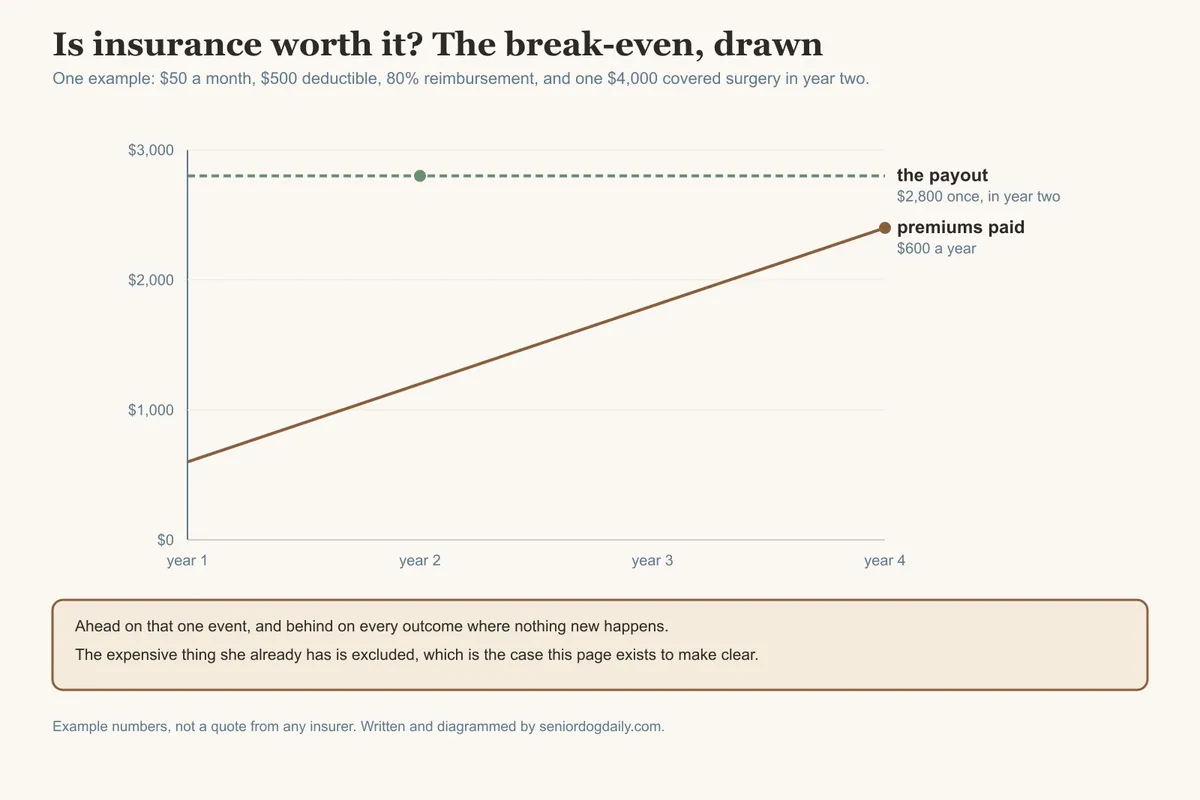
- Premium: $50 a month, so about $600 a year
- Deductible: $500 a year, then 80% reimbursement
- Suppose she develops a condition with a $4,000 surgical bill in year two
Over two years you paid $1,200 in premiums. The claim pays 80% of the amount over the deductible: $4,000 minus $500 is $3,500, and 80% of that is $2,800. You still pay the other 20%, which is $700, plus the $500 deductible. Out of pocket that is $1,200 in premiums plus $1,200 of the bill, $2,400 against a $4,000 surgery, so you are ahead by $1,600 on that one event. The $500 deductible is already out of the $2,800; it is not subtracted again.
Now run the same policy on the other outcomes. If she never has a claim, you are down $1,200 with nothing to show for it. If the expensive thing is the arthritis she already had, the claim is refused and you are down the same $1,200. The policy pays off when a new expensive thing happens early in the policy's life, and that is the case it is designed for.
When It Is Clearly Worth Buying
- She is in the middle of the senior years, not the end. A dog at eight with a clean record has years in which a new diagnosis can land.
- She is a breed with a known expensive risk ahead of her, and you can get the specific answer in writing about whether that risk is covered at her age.
- You would genuinely struggle with a five-figure bill. This is the real reason insurance exists. If a $10,000 emergency would mean borrowing at a bad rate or choosing between treatment and rent, the premium is buying something real, whatever the expected-value arithmetic says.
- The five answers above came back clean, meaning the exclusions are narrow enough that a future diagnosis has somewhere to land.
When It Is Clearly Not Worth Buying
- She is at or near the end of her breed's expected lifespan and in poor health. The premium buys a small chance of a short payout, and the money is more useful as savings.
- Everything she is likely to need is already diagnosed. Then the policy covers the next thing only, and you should price it as such rather than as cover for the dog in front of you.
- The quote comes back high and you have savings. At that point you are paying an insurer's margin to smooth a bill you could absorb, which is the definition of a bad deal for you and a good one for them.
- The waiting period or the pre-existing definition leaves an obvious hole for the condition you are actually worried about.
If the Answer Is No, What Replaces It
Self-insuring is not the same product, and it is honest to say so: a savings account cannot cover a $12,000 bill in month three, which is exactly the risk insurance transfers. What it can do is cover the ordinary expensive things, dental work, a lump removal, chronic medication, and it has no exclusions and no claim denials. Money set aside earns whatever your account pays; the FDIC's national rate for a savings account was 0.37% as of September 2026, and high-yield online accounts pay more than that. Payment plans, low-cost clinics and assistance programs are a separate subject, and we are working on that page next.
One more thing worth doing whichever way you decide: get a written estimate for the procedure you are most afraid of. Ask your vet what a splenectomy, a dental with extractions, or a night in the emergency hospital costs at their practice. That number is the one that actually decides this question, and it is free to ask.
Frequently Asked Questions
Is pet insurance worth it for an old dog?
It can be, and the deciding factor is how much of her likely care is already excluded. Insurance covers conditions that begin after the policy starts, so a dog with several diagnoses is buying cover for the next thing only. If her existing conditions are the expensive ones, the policy will not pay for what you are worried about.
Should I insure my senior dog or put the money in savings?
Savings wins if you could absorb a large bill without borrowing and if the quote is high. Insurance wins if a five-figure bill would be a crisis, or if she is early in the senior years with a clean record and a breed risk ahead of her. If she never has a covered claim, the example on this page is the premiums paid and nothing back. If the expensive thing is a condition she already has, the claim is refused and those premiums are spent the same way.
Does pet insurance cover pre-existing conditions in senior dogs?
The providers we checked each state the exclusion in their own terms, and in states that have adopted the model act the insurer has to disclose it before you buy. What varies is what counts as pre-existing, where a recorded symptom can matter as much as a diagnosis, and whether a condition that later resolves can become coverable.
Can I buy pet insurance for a 15-year-old dog?
At least one insurer writes an age cutoff on its own page. This page does not repeat that sentence. A shortened version can turn an enrollment limit into a coverage limit, and the provider comparison page keeps the insurer's own wording, with the link. Whether the others have an equivalent limit is a question for their quote tool and their terms, in writing, before you pay.
Sources
- State of New Hampshire, RSA 402-P:3, Disclosures (pet insurance). Source of the statement that an insurer must disclose what a policy excludes, including a preexisting condition, a hereditary disorder, a congenital anomaly or disorder, or a chronic condition. Checked 2026-09-26. gc.nh.gov
- Federal Deposit Insurance Corporation, National Rates and Rate Caps, September 2026. Source of the 0.37% national rate for savings accounts. Checked 2026-09-26. fdic.gov
Both figures above also appear, with the provider wording they relate to, in our guide to pet insurance for senior dogs. That page carries the per-provider terms and their own words; this one carries the decision arithmetic, and where the two overlap the wording is deliberately identical.
Keep Reading
- Pet insurance for senior dogs, what each provider says about age and pre-existing conditions, in their own words
- When is a dog considered senior, the age chart behind "early in the senior years"
- What the numbers on a senior dog's bloodwork mean, the baseline that makes an exclusion argument possible
- Quality of life scale, for the decision insurance is not designed to pay for
Write down your vet's estimate for the procedure you fear most, and put the number next to your quote. The comparison stops being abstract at that point.
About the authors
Sarah Bennett researches senior dog care from a home centered on her Border Collie, Lucy. I am not a veterinarian and this is not financial advice; the disclosure requirement on this page is quoted from the state statute and linked, and the worked example is labeled as an example rather than a quote.
Leo Bennett handles the reading and fact-checking behind these pieces, including checking that the figures used here match the wording on our own provider page, since two pages stating the same fact differently is how a site starts contradicting itself.
Sarah and Leo Bennett are pen names. Senior Dog Daily is written and checked by a small editorial team; see About.