
Furosemide (Lasix) for Dogs With Heart Failure: The First Dose, Side Effects, and When to Call
By Sarah Bennett · Last updated September 22, 2026 · 11 min read
Furosemide for dogs is the drug that gets a dog in heart failure breathing again, and it is usually the first bottle in the bag when she comes home from the hospital. It works fast, it works by making her produce a great deal of urine, and the trade it makes is one every owner should understand before the first dose: it pulls water off the lungs, and it pulls it from everywhere else too. This page covers what the first day looks like, which side effects are the drug doing its job, which ones mean stop and call, and why your vet wants blood rechecked within two weeks.
Nothing here is a dose. Furosemide dosing in heart failure is adjusted dog by dog, sometimes week by week, against kidney values only your vet can see, and the numbers on this page are quoted from the label and the guidelines to explain what the vet is doing, not to replace it.
What Furosemide Does for a Dog in Heart Failure, and How Fast
Furosemide (the brand names are Lasix and Salix) is a loop diuretic. It makes the kidneys pass more sodium and water into the urine, which lowers the fluid volume pressing back into the lungs. The FDA-approved Salix label states the indication plainly: "Salix ® is indicated for the treatment of edema (pulmonary congestion, ascites) associated with cardiac insufficiency and acute noninflammatory tissue edema." Pulmonary congestion is fluid in the lungs; ascites is fluid in the belly. Both are what heart failure produces, and both are what this drug removes.
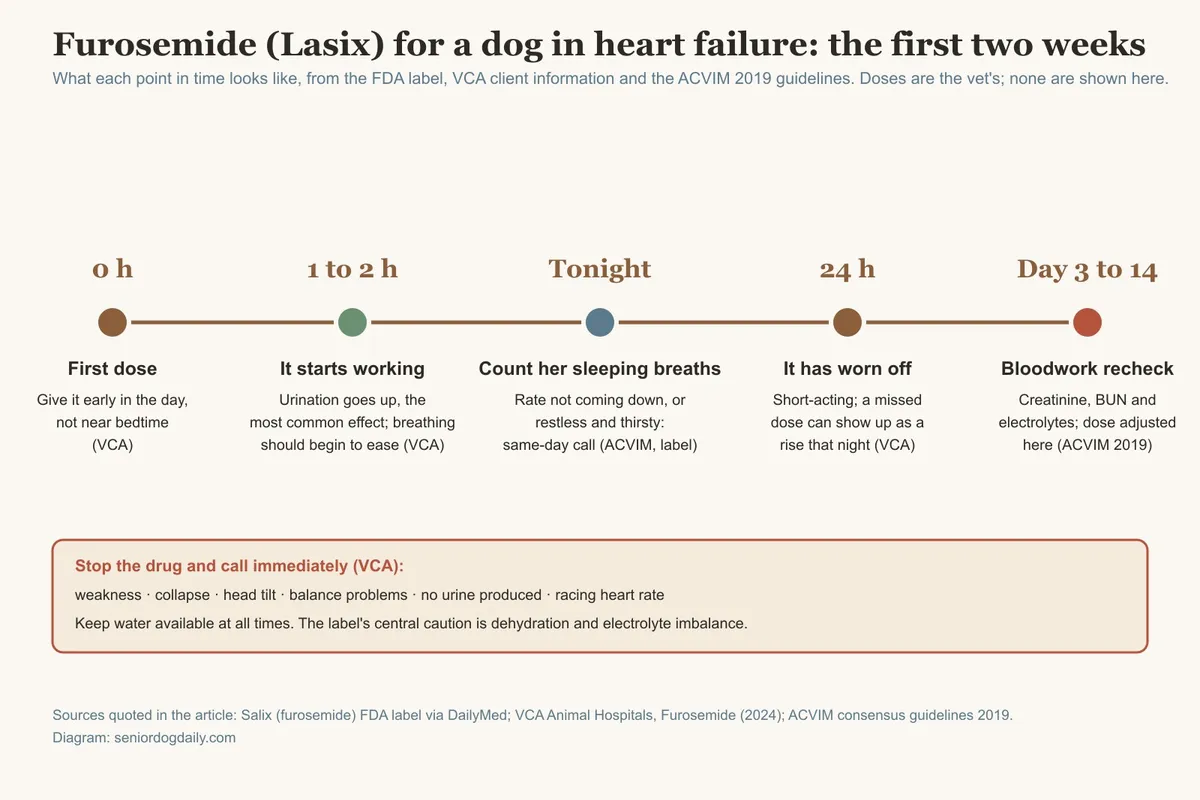
It is quick. VCA's furosemide client sheet says "This medication will take effect quickly, in about 1 to 2 hours, and improvement in clinical signs should follow." and, at the other end, "This short-acting medication should stop working within 24 hours, although effects can be longer in pets with liver or kidney disease." That is why it is given every day, often more than once, and why a missed dose matters more than with a slow drug.
For where furosemide sits among the other heart medications, and what the stages mean for how long she has, see congestive heart failure stages and life expectancy. This page is only about this one drug.
The First Dose: What Is Normal
Most of what you will see in the first 24 hours is the drug working.
She will urinate a lot, and soon. The same VCA sheet lists "increased urination (most common)" first among the side effects, and its practical instruction follows from it: "Avoid dosing close to bedtime, as this medication causes frequent urination." Give the morning dose early and plan the last dose of the day so she can get outside afterward; a house-trained dog who wets the bed on furosemide is not losing her training.
She will be thirsty. Let her drink. The sheet is direct: "Ensure your pet always has access to plenty of fresh, clean water while on this medication." Restricting water to reduce the urination is the one mistake that turns a working drug into a dangerous one, because the label's central caution is that furosemide "if given in excessive amounts may result in dehydration and electrolyte imbalance." Water is how she stays on the right side of that line.
With or without food. The sheet says "It may be given with or without food; however, if vomiting occurs when dosed on an empty stomach, give future doses with food or a treat."
Her breathing should ease. If she was coughing, breathing fast, or unable to settle, the improvement should be noticeable within hours, and her sleeping breathing rate is how you confirm it. Count it that first night; our resting breathing rate counter times it and keeps the number.
"She Is Panting More After the First Dose": How to Read It
Owners write this one often: the first dose went in, and instead of settling she seems more restless, panting, up and down. Two things can produce it, and both are a same-day call rather than a wait.
The first is that the fluid is not gone yet. One dose does not always clear a chest that took weeks to fill, and a dog who is still breathing fast at rest four to six hours after the dose is still in failure. The number that separates "settling" from "still in trouble" is her resting breathing rate, and the ACVIM guidelines are explicit that "identification of increases in resting respiratory rate above normal baseline has the best predictive value for impending clinical decompensation." A rate that is not coming down is the vet's cue to adjust, and they would rather hear it tonight.
The second is the drug overshooting. The Salix label lists what that looks like: "Early signs of electrolyte imbalance are: increased thirst, lethargy, drowsiness or restlessness, fatigue, oliguria, gastro-intestinal disturbances and tachycardia." Restlessness is on that list, and so is a fast heart rate, and an owner cannot tell from the couch which of the two is going on. That is the point: you do not have to. Count her breathing, note whether she has urinated, and call.
When to Stop and Call Immediately
VCA's sheet draws a hard line for owners: "If any of the following signs develop, stop giving furosemide and contact your veterinarian immediately". The signs it lists are weakness, collapse, a head tilt, balance problems, signs of electrolyte imbalance, no urine being produced, and a racing heart rate. Two of those deserve a note.
No urine. A dog on a diuretic who has not urinated in many hours needs to be seen that hour, because the label says "Salix ® is contraindicated in anuria." That is an emergency-clinic visit, not a morning appointment.
Collapse or weakness. In a heart failure dog, collapse can be the heart, the blood pressure, or the potassium, and none of those is sorted out at home. Our senior dog collapse page covers what to do in the minutes after.
Vomiting or diarrhea on their own are on the milder list, but in a dog losing water through her kidneys all day, a day of vomiting is a faster road to dehydration than it would be otherwise. If it lasts more than one or two episodes, call.
Why the Vet Wants Blood Rechecked Within Two Weeks
This is the part of the plan owners most often skip, because the dog looks better and the visit costs money. Do not skip it. The ACVIM guidelines recommend it in so many words: "Measurement of serum creatinine, blood urea nitrogen, and electrolyte concentrations 3‐14 days after initiating furosemide treatment is recommended for animals with Stage C heart failure." Creatinine and BUN are the kidney values; the electrolytes are sodium, potassium, and chloride. The label asks for the same thing from the drug's side: "Clinical examination and serum BUN, CO2 and electrolyte determinations should be performed during the early period of therapy and periodically thereafter, especially in refractory cases."
The reason is the trade described at the top. The kidneys are doing the drug's work, and an older dog's kidneys may already be running with less margin than they had at five. The recheck tells the vet whether the dose that cleared her lungs is one her kidneys can carry, and it is the visit where doses get adjusted. If your dog also has known kidney disease, our senior dog kidney disease page explains why those two conditions pull in opposite directions and how vets balance them.
On potassium: owners sometimes read that furosemide "wastes potassium" and reach for a supplement. The guidelines are specific that this is a test-first decision; the ACVIM panel says to "supplement the diet with potassium from either natural or commercial sources only if hypokalemia is identified." Adding potassium without a blood test is how a dog on an ACE inhibitor and spironolactone ends up with too much of it.
Why the Dose Will Change, in Both Directions
Furosemide is not a fixed prescription. The label describes the pattern most dogs follow: "For long-term treatment, the dose can generally be lowered after the edema has once been reduced." A dog who came home on a crisis dose may be stepped down over the following weeks to the lowest amount that keeps her breathing rate normal, because every milligram above that is extra work for the kidneys with no benefit to the lungs.
The other direction is the one the stage system is built around. When the dose has to keep rising to hold the fluid back, the disease is progressing, and cardiologists use the furosemide requirement itself as the marker. The ACVIM guidelines define the last stage by it: "Stage D dogs thus require more than a total daily dosage of 8 mg/kg of furosemide or the equivalent dosage of torsemide, administered concurrently with standard doses of the other medications thought to control the clinical signs of heart failure". That number is a definition for vets, not a target for anyone, and what it means for time is on the stages and life expectancy page. If your vet starts talking about torsemide, that is the drug they move to when furosemide is no longer holding.
If You Miss a Dose
The VCA sheet gives the rule: "If you miss a dose, give it as soon as you remember, and then continue with the regular dosing schedule. However, if it is almost time for the next dose, skip the missed dose and resume the regular dosing schedule. Do not give the pet two doses at once." Because the drug wears off within a day, a missed dose can show up as a rise in her breathing rate that night; if it does, that is a call, and it is worth telling the vet the dose was missed rather than letting them read it as progression.
Three Things to Track at Home
Everything above comes down to three numbers written in one place.
- Her sleeping breathing rate, every evening for the first two weeks and three or four times a week after. It is the number the vet will ask for first, and the one that decides dose changes. The counter keeps them on your phone.
- Her weight, weekly on the same scale. Fluid coming off shows up as weight coming off; fluid coming back shows up first on the scale.
- Water and urine, roughly. You do not need measurements, just whether she is drinking and producing urine every day, because the day she stops is the day on the emergency list.
Counting by hand for two weeks is easy; counting for a year of ordinary nights is where it slips. If it does, a collar sensor can take over the first item: Maven Pet logs resting respiratory rate and heart rate through the night and flags a rising trend, which is exactly what a dose adjustment is decided on. It does not diagnose and it does not replace the recheck. Our Maven Pet review covers what it measures and what it does not. Maven is an affiliate partner; if you subscribe through that link we may earn a commission at no extra cost to you, and it does not change the advice on this page to count by hand first.
Frequently Asked Questions
How long does furosemide take to work in dogs?
About one to two hours to start, according to VCA's client information, with improvement in breathing following. It wears off within about 24 hours in a dog with normal liver and kidney function, which is why it is dosed daily.
Can a dog be on furosemide long term?
Yes; most dogs with heart failure stay on it for the rest of their lives, at the lowest dose that keeps fluid off the lungs. The label notes the dose can often be lowered once the initial fluid has cleared, and the trade for long-term use is periodic bloodwork to watch kidney values and electrolytes.
What happens if a dog misses a dose of furosemide?
Give it when you remember unless the next dose is close, and never double up. Because the drug is short-acting, a missed dose can let fluid creep back the same night; watch her breathing rate and call if it rises.
Does furosemide make dogs tired?
VCA's common side-effect list is increased urination, diarrhea, and constipation; lethargy appears instead on the label's list of early signs of electrolyte imbalance, along with increased thirst, restlessness, and a fast heart rate. A dog who becomes flat or weak on furosemide needs bloodwork, not a wait.
Sources
- Merck Animal Health. Salix (furosemide) Tablets, FDA-approved label. DailyMed, U.S. National Library of Medicine. Source of the indication, the dehydration and electrolyte cautions, the early signs of electrolyte imbalance, the monitoring statement, the anuria contraindication, and the long-term dosing statement. Checked 2026-09-22. dailymed.nlm.nih.gov
- Forsythe LR, Gollakner R. Furosemide. VCA Animal Hospitals client information (LifeLearn), updated 2024-08-07. Source of onset and duration, administration notes, side effects, the stop-and-call list, and the missed-dose rule. Checked 2026-09-22. vcahospitals.com
- Keene BW, Atkins CE, Bonagura JD, et al. ACVIM consensus guidelines for the diagnosis and treatment of myxomatous mitral valve disease in dogs. Journal of Veterinary Internal Medicine, 2019. Source of the recheck recommendation, the potassium statement, the resting respiratory rate statement, and the Stage D definition. Checked 2026-09-22. pmc.ncbi.nlm.nih.gov
Keep Reading
- Congestive heart failure stages and life expectancy, where this drug fits and what the stages mean
- Resting breathing rate counter, the number every dose change is based on
- Heart disease in senior dogs, for a dog not yet diagnosed
- Senior dog kidney disease, the organ that carries this drug's work
Put the recheck appointment in your calendar tonight, before she looks better and it starts to feel optional.
About the authors
Sarah Bennett researches senior dog care from a home centered on her Border Collie, Lucy. I am not a veterinarian; every clinical statement on this page is quoted from the FDA-approved label, VCA's client information, or the ACVIM guidelines and linked at the claim, and no dose on this page is a recommendation.
Leo Bennett handles the reading and fact-checking behind these pieces, including confirming that the Stage D furosemide figure is quoted as the guidelines' definition and not as anything an owner should aim for.
Sarah and Leo Bennett are pen names. Senior Dog Daily is written and checked by a small editorial team; see About.