
Congestive Heart Failure in Senior Dogs: Stages and Life Expectancy
By Sarah Bennett · Last updated September 21, 2026 · 12 min read
Congestive heart failure in dogs life expectancy is not one number, and the vet who would not give you one was being honest rather than evasive. The same diagnosis covers a dog who has years ahead and a dog who has months, and what separates them is the stage she is in, whether she was found before or after her first crisis, and how her body handles the drugs. This page lays out the four stages cardiologists use, the median survival each stage has produced in published studies, and the single number you can count at home that tells you which way she is heading.
The figures below come from the studies themselves, quoted as they were published, with the study populations named. They are medians of groups of dogs. Your dog sits somewhere in each distribution, and where depends on things the studies also identified: how enlarged her heart is, what breed she is, how much diuretic she needs, and how her kidneys are holding up. Read the numbers as the shape of the road, not the length of hers.
What the Four Stages of Heart Failure in Dogs Mean
The disease behind most heart failure in older small and medium dogs is myxomatous mitral valve disease, a slow degeneration of the valve between the left atrium and left ventricle that lets blood leak backward. The American College of Veterinary Internal Medicine sorts it into stages A through D, and the 2019 ACVIM consensus guidelines define the ones that matter for prognosis. Stage B2 "refers to asymptomatic dogs that have more advanced mitral valve regurgitation that is hemodynamically severe and long‐standing enough to have caused radiographic and echocardiographic findings of left atrial and ventricular enlargement that meet clinical trial criteria used to identify dogs that clearly should benefit from initiating pharmacologic treatment to delay the onset of heart failure (specific criteria detailed below)."
In plain terms:
- Stage A: a breed at risk, no murmur yet. The guidelines describe it as dogs "at high risk for developing heart disease but that currently have no identifiable structural disorder of the heart".
- Stage B1: a murmur, but the heart has not enlarged enough to act on.
- Stage B2: a murmur and a heart that has enlarged past a set threshold, still no symptoms. This is where treatment starts.
- Stage C: the dog has had at least one episode of actual heart failure, fluid in or around the lungs, and is controlled on standard medication. The same guidelines put it as "Stage C includes all dogs with MMVD that have experienced an episode of clinical heart failure and that are not refractory to standard heart failure treatment (standard treatment is defined below)."
- Stage D: the standard drugs no longer hold the fluid back. The guidelines give it an operational definition: "Stage D dogs thus require more than a total daily dosage of 8 mg/kg of furosemide or the equivalent dosage of torsemide, administered concurrently with standard doses of the other medications thought to control the clinical signs of heart failure". The dose is how cardiologists draw the line, not a target for anyone to reach at home.
Most dogs whose owners search this question are in Stage C: she had a bad night, she was hospitalized, she came home on pills. Some are in B2, told at a checkup that the heart is enlarged and that a drug should start now. A few are being told the drugs have stopped working, which is D. The stage is the first thing to ask your vet to name out loud, because every number that follows depends on it.
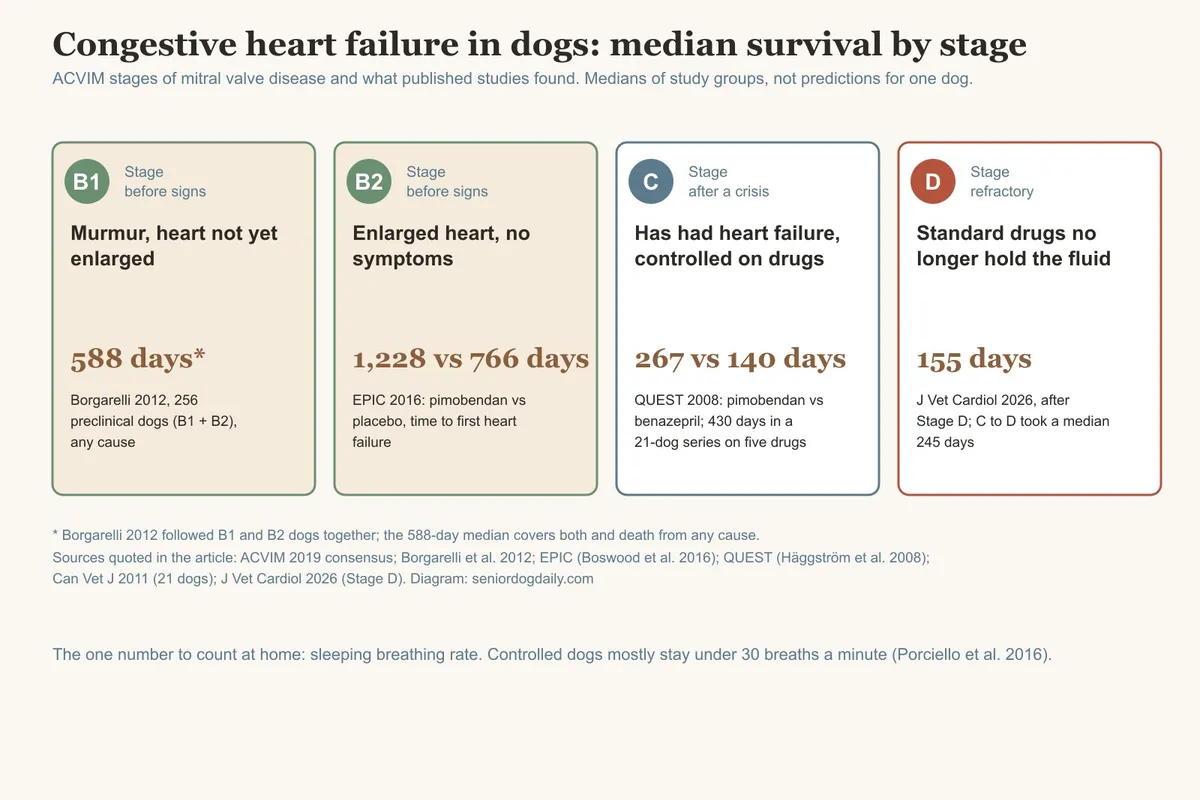
Life Expectancy by Stage: What the Studies Found
| Stage and treatment | Study | What was measured | Result |
|---|---|---|---|
| B1 and B2, mostly untreated | Borgarelli 2012, 256 dogs | Survival from first exam, any cause | Median 588 days |
| B2, on pimobendan vs placebo | EPIC 2016 | Time to first heart failure or cardiac death | 1,228 vs 766 days |
| C, pimobendan vs benazepril | QUEST 2008, 252 dogs analyzed | Time to cardiac death, euthanasia or treatment failure | 267 vs 140 days |
| C, on five drugs together | Canadian series 2011, 21 dogs | Survival from onset of heart failure | Median 430 days |
| C progressing to D | J Vet Cardiol 2026 | Time from Stage C to Stage D | Median 245 days |
| D | J Vet Cardiol 2026 | Survival after Stage D, cardiac death | Median 155 days |
Before symptoms (B1 and B2). In a 2012 study of 256 dogs with preclinical disease, followed without a standard treatment protocol, "The median survival time, regardless of cause of death, was 588 (range 75-1,668) days." The same paper notes that "Seventy of 256 (27.3%) dogs died during the observation period." The range is the point: a dog found at a murmur check can have a few months or four and a half years, and at this stage most dogs are still dying of something else.
B2 with pimobendan. The EPIC trial is the reason your vet may want to start a drug before there are any symptoms. Dogs with an enlarged heart and no signs were given pimobendan or a placebo, and the published results report that "Median time to primary endpoint was 1228 days (95% CI: 856–NA) in the pimobendan group and 766 days (95% CI: 667–875) in the placebo group". The authors' summary of what that means: "Prolongation of preclinical period by approximately 15 months represents substantial clinical benefit." That is the strongest evidence in canine cardiology that timing matters, and it is the argument for acting on a B2 finding rather than waiting for a cough.
Stage C. Once a dog has had heart failure, the clock is shorter and the drug choice shows up in the numbers. In the QUEST study, which randomized 252 dogs in heart failure, "One hundred and ninety dogs reached the primary endpoint; the median time was 188 days (267 days for pimobendan, 140 days for benazepril hazard ratio = 0.688, 95% confidence limits [CL]=0.516-0.916, P= .0099)." Those dogs were on conventional therapy plus one of the two drugs, in 2008. A smaller Canadian series of 21 dogs treated with furosemide, an ACE inhibitor, pimobendan, spironolactone and amlodipine together reported that the "Median survival time (MST) was 430 d." Twenty-one dogs is a small group and the number should be read as evidence that long survival is possible on combined treatment, not as a promise.
The slide from C to D, and D itself. This is the part owners ask about most. A 2026 study in the Journal of Veterinary Cardiology opens by noting that "Data on dogs with end-stage myxomatous mitral valve disease (MMVD) are sparse." and then followed dogs who crossed the furosemide threshold. It found that "The median time needed to progress from the ACVIM stage C to D was 245 days (144-376 days)" and that "After diagnosis of stage D, the median survival time for cardiac-related death was 155 days (103-259 days)." Put the two together and a dog diagnosed in Stage C has, at the median, something over a year before the drugs stop holding, and about five months after. Half of dogs do better than that, half worse.
Why Two Dogs With the Same Diagnosis Get Different Numbers
The studies above all identified what moved a dog to one side of the median or the other, and the list is consistent.
When she was found. The EPIC and Borgarelli figures are for dogs caught before symptoms; the QUEST and Stage D figures are for dogs caught after a crisis. A dog whose murmur was heard at nine and echoed at ten is on a different curve from a dog whose first sign was a night in the oxygen cage. This is the case for annual auscultation in the breeds at risk, and it is the case for the senior wellness exam even when nothing seems wrong.
Heart size. Every study ties survival to how enlarged the left atrium is. It is the reason the vet wants an echocardiogram rather than treating on the murmur alone, and the reason the report's numbers matter more than the grade of the murmur.
Breed and kidneys. The QUEST abstract states that "A longer time to reach the endpoint was also associated with being a Cavalier King Charles Spaniel, requiring a lower furosemide dose, and having a higher creatinine concentration." In that study, Cavaliers lived longer with the disease than the other breeds once in failure. The diuretic dose is a marker: a dog who stays comfortable on a low dose has more road than one who needs the dose raised every month. Kidney values matter because the diuretics that keep fluid off the lungs also stress the kidneys, and the balance between the two organs is what the vet is managing at every recheck.
Which drugs, and when. Pimobendan, an ACE inhibitor, furosemide and spironolactone are the standard four in Stage C. The ACVIM panel recommends pimobendan from B2 onward; the EPIC and QUEST results are why. Whether your dog is on it, and at what stage it started, is a fair question to ask, and the answer belongs to your vet, who knows her kidney values and her blood pressure.
The One Number to Count at Home: Resting Breathing Rate
Every cardiologist's monitoring plan comes down to a number an owner can take with a phone timer. The ACVIM guidelines are direct about why: "Of these variables, identification of increases in resting respiratory rate above normal baseline has the best predictive value for impending clinical decompensation." Fluid starts to gather in the lungs before a dog coughs or struggles, and the first thing it changes is how many breaths she takes when she is asleep.
How to count it: wait until she is fully asleep, or at least lying still and calm for several minutes. Count the rises of her chest for 30 seconds and double it. Do it at the same time each evening, write it down, and do it three or four times a week when she is stable. What you are building is her baseline, because the trend matters more than any single reading. Our resting breathing rate counter does the timing and doubling for you and keeps the readings on your phone, with a line at 30.
What the numbers mean: in a study of dogs and cats whose heart failure was controlled on medication, the authors concluded that "These data suggest that most dogs and cats with CHF that is medically well-controlled and stable have SRRmean and RRRmean <30 breaths/min at home." VCA's owner guidance on the disease describes the same measure: "Your veterinarian may recommend you monitor your pet's resting respiratory rate (RRR)." Your vet will give you the threshold for your dog; a sleeping rate that climbs above her usual number on two consecutive nights, or a single count above the number the vet named, is a call, not a wait-and-see. It is the earliest, cheapest warning the disease offers, and it is the reason many dogs in Stage C get their dose adjusted at a routine phone call instead of at the emergency clinic.
Counting is easy to start and hard to keep up over a year of good nights. If the habit slips, a collar sensor can carry it: Maven Pet logs resting respiratory rate and heart rate through the night and flags a rising trend, which is exactly the signal the guidelines describe. It does not diagnose and it does not replace the vet; it counts when you cannot. Our Maven Pet review covers what it measures and what it does not. Maven is an affiliate partner; if you subscribe through that link we may earn a commission at no extra cost to you, and it does not change what this page says about counting by hand.
Signs the Stage Is Changing
Stage C becomes Stage D slowly, and the signs are ordinary enough to miss. The ones cardiologists watch, and the ones worth writing on the same page as her breathing counts:
- The diuretic keeps going up. Each increase holds for a shorter time. This is the definition of the slide, and the vet will tell you when the dose has crossed into D.
- Appetite and weight. She eats less, or picks; muscle comes off her spine and hips even as her belly stays round. Weigh her weekly on the same scale.
- Where she sleeps. A dog who starts sleeping sitting up, or with her neck stretched out, is choosing the position that eases her breathing.
- A swollen belly that was not there a month ago, which can be fluid.
- Fainting, or collapse after excitement or a walk, covered in senior dog collapse.
- Coughing at rest rather than after activity, and panting that does not settle.
None of these is a verdict on its own. Together, with a breathing count that keeps climbing, they are the conversation to have with your vet about what Stage D means for your dog, and when it becomes a quality of life question rather than a medication question. The when to put your dog down page has the framework for that conversation; the heart-specific version is that the last stretch of Stage D is often short, and dogs in respiratory distress do not get to choose their timing the way a dog with a slower disease does.
For the Owner Who Just Got Home From the Hospital
If she was hospitalized this week and you are reading this at night: her first crisis put her in Stage C. The medians for that stage run from several months to over a year on modern treatment, and the range around them is wide in both directions. The things that move her toward the long end are the ones you can help with: giving the drugs on schedule, counting her breathing every evening, keeping the rechecks the vet schedules for her kidney values, and calling early when the count climbs rather than waiting for a cough. The things you cannot change, her heart size and her breed, were set before you got the diagnosis, and no amount of counting will move them. Do the part that is yours and let the vet carry the rest.
Frequently Asked Questions
How long can a dog live with congestive heart failure without treatment?
None of the studies quoted on this page measured it, and withholding treatment from a dog in heart failure is not something anyone would randomize. The untreated preclinical figure, a median of 588 days in Borgarelli's 256 dogs, applies to dogs before their first episode. Once fluid has reached the lungs, untreated dogs are in respiratory distress within days, and the question becomes a comfort decision rather than a survival one.
What are the final stages of congestive heart failure in dogs?
Stage D, by the ACVIM definition, is failure that standard drugs no longer control, marked in practice by a daily furosemide requirement above 8 mg/kg. In the 2026 Journal of Veterinary Cardiology series, dogs took a median of 245 days to move from Stage C to D and lived a median of 155 days after. The signs are rising diuretic doses, weight and appetite loss, a swollen belly, sleeping upright, and breathing counts that no longer come back down.
Can a dog recover from congestive heart failure?
The valve does not heal on medication, so recovery in the sense of cure means surgery, and the ACVIM panel frames that narrowly: "Surgical intervention in advanced Stage B2 is possible and recommended by some panelists for clients who can afford and access mitral valve repair at the few centers demonstrating evidence of acceptably low complication rates and effective, durable results." What treatment can do is take a dog from a crisis back to a comfortable, controlled Stage C, sometimes for a long time. The QUEST and Canadian figures, medians of 267 and 430 days, are for dogs in exactly that controlled state.
Is congestive heart failure painful for dogs?
The fluid buildup is not painful in the way arthritis is, but the sensation of not being able to get enough air is distressing, and that is what a crisis feels like to her. Controlled heart failure, with a normal sleeping breathing rate, is a comfortable state; the counting exists so that she spends as little time as possible outside it.
Sources
- Keene BW, Atkins CE, Bonagura JD, et al. ACVIM consensus guidelines for the diagnosis and treatment of myxomatous mitral valve disease in dogs. Journal of Veterinary Internal Medicine, 2019. Source of the stage definitions, the Stage D furosemide threshold, and the resting respiratory rate statement. Checked 2026-09-21. pmc.ncbi.nlm.nih.gov
- Borgarelli M, Crosara S, Lamb K, et al. Survival characteristics and prognostic variables of dogs with preclinical chronic degenerative mitral valve disease attributable to myxomatous degeneration. Journal of Veterinary Internal Medicine, 2012. 256 dogs, Stage B1 and B2. Checked 2026-09-21. pubmed.ncbi.nlm.nih.gov
- Boswood A, Häggström J, Gordon SG, et al. Effect of Pimobendan in Dogs with Preclinical Myxomatous Mitral Valve Disease and Cardiomegaly: The EPIC Study. Journal of Veterinary Internal Medicine, 2016. Checked 2026-09-21. pmc.ncbi.nlm.nih.gov
- Häggström J, Boswood A, O'Grady M, et al. Effect of pimobendan or benazepril hydrochloride on survival times in dogs with congestive heart failure caused by naturally occurring myxomatous mitral valve disease: the QUEST study. Journal of Veterinary Internal Medicine, 2008. 252 dogs in Stage C. Checked 2026-09-21. pubmed.ncbi.nlm.nih.gov
- Survival and echocardiographic data in dogs with congestive heart failure caused by mitral valve disease and treated by multiple drugs: a retrospective study of 21 cases. Canadian Veterinary Journal, 2011. Checked 2026-09-21. pmc.ncbi.nlm.nih.gov
- Clinical findings and survival time in dogs with myxomatous mitral valve disease at the American College of Veterinary Internal Medicine stage D. Journal of Veterinary Cardiology, 2026. Source of the Stage C to D and post-D medians. Checked 2026-09-21. pubmed.ncbi.nlm.nih.gov
- Porciello F, Rishniw M, Ljungvall I, et al. Sleeping and resting respiratory rates in dogs and cats with medically-controlled left-sided congestive heart failure. The Veterinary Journal, 2016. Checked 2026-09-21. pubmed.ncbi.nlm.nih.gov
- VCA Animal Hospitals. Congestive Heart Failure in Dogs. Owner guidance on resting respiratory rate. Checked 2026-09-21. vcahospitals.com
Keep Reading
- Heart disease in senior dogs, the cough, the murmur and the home test, for a dog not yet diagnosed
- Maven Pet review, the collar sensor that counts breathing overnight
- Senior dog collapse, when fainting enters the picture
- Quality of life scale, for Stage D
Count her breathing tonight while she sleeps, and write the number down. Tomorrow's number only means something next to it.
About the authors
Sarah Bennett researches senior dog care from a home centered on her Border Collie, Lucy. I am not a veterinarian; every survival figure on this page is quoted from the study that produced it and linked at the claim, and the stage definitions are the ACVIM panel's own words.
Leo Bennett handles the reading and fact-checking behind these pieces, including confirming that each median in the table is matched to the population and treatment it was measured in, since the same disease produces very different numbers depending on which dogs were counted.
Sarah and Leo Bennett are pen names. Senior Dog Daily is written and checked by a small editorial team; see About.