
Maven Pet vs PetPace: Which Health Monitor Fits a Senior Dog? (2026)
This is a synthesized first-person planning exercise, not a real purchase or a hands-on test. Product facts and prices were checked on 2026-11-13 UTC; verify the checkout before buying.
I had already decided I wanted a health monitor. The question was which one. Maven looked almost too cheap to be serious. PetPace looked like the version a veterinary clinic would recommend. The price gap was more than $400 in the first year, and I wanted to know what that money actually bought.
The answer is not "the more expensive one is better." The answer is that they are built for different buyers, and the difference is easier to see once the feature list is translated into a job.
The one-minute verdict
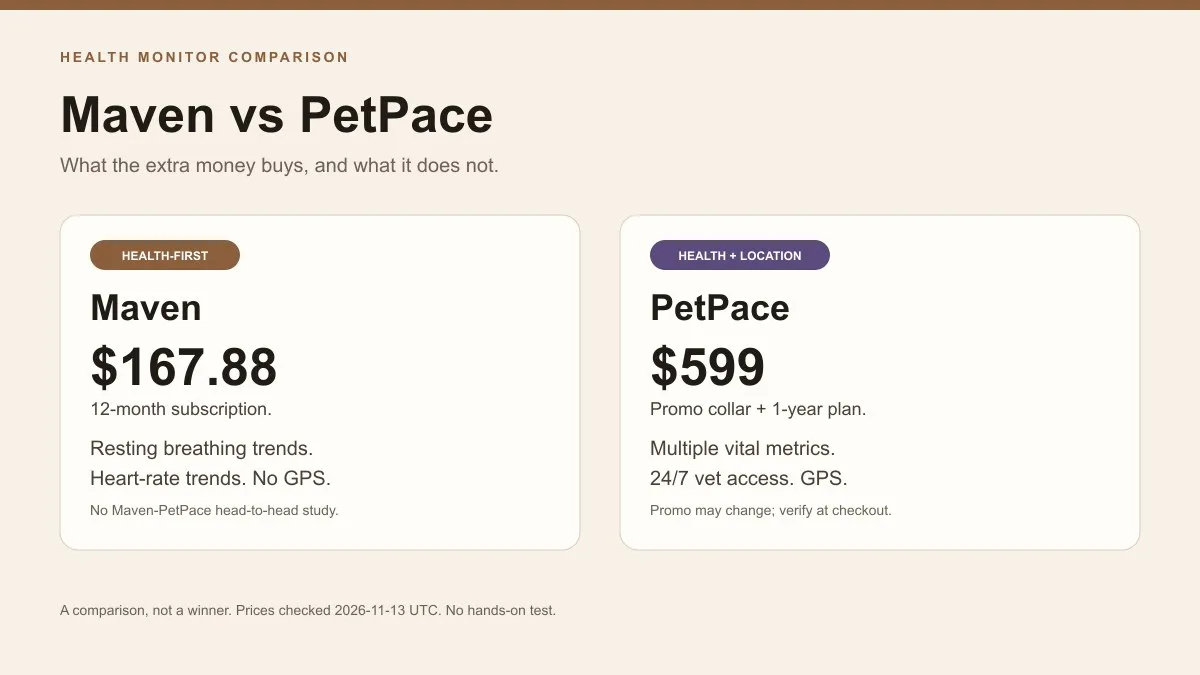
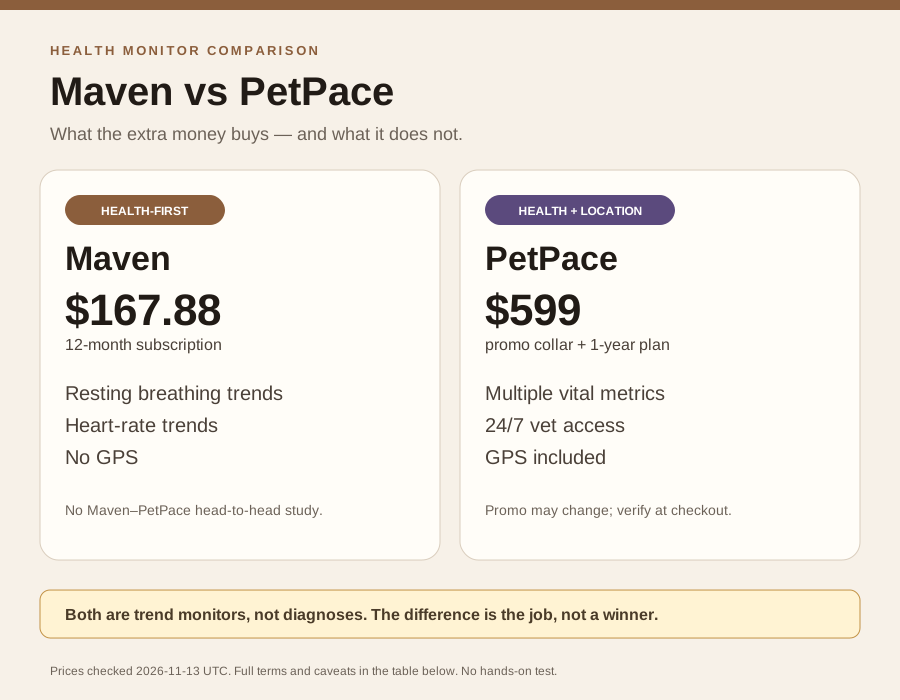
Maven is the lower-cost, heart-focused option. It tracks resting respiratory rate and heart-rate trends, plus activity, sleep, scratching, and drinking. It has no GPS. The annual plan is $13.99 a month, which works out to $167.88 for twelve months; the monthly plan is $25 a month with a six-month minimum.
PetPace is the broader device. The PetPace 3.0 page lists GPS, temperature, pulse, HRV, posture, calories, and 24/7 vet access. The collar is $299 after a current $100 Holiday Season promotion, down from $399, and the one-year plan is billed at $300. That puts the first year at about $599 before renewal.
If the question is "is my senior dog's resting breathing trend changing, and I do not need GPS," Maven is the more direct purchase. If the question is "I want location, more vitals, and vet access in one device, and I will pay for it," PetPace is the stronger fit. If location is the main job, neither is the cheapest first stop.
This is not an accuracy ranking. There is no head-to-head study in this evidence set.
What each device actually measures
The feature table is where the price gap starts to make sense.
| Maven | PetPace 3.0 | |
|---|---|---|
| Resting respiratory rate | Yes | Respiration |
| Heart rate | Heart-rate trends | Pulse and HRV |
| Temperature | No | Yes |
| Activity and sleep | Yes | Yes |
| Scratching and drinking | Yes | Behavior/activity; verify the exact metric |
| GPS and safe zone | No | Yes |
| Vet output | Vet-ready report | Share-with-vet report plus 24/7 vet access |
| Connectivity | Wi-Fi sync | 4G LTE Cat-M1, Wi-Fi, GPS |
| Battery | Usually 5–7 days | 3–4 weeks standard; 48–72 hours intensive |
| Hardware | Included in subscription | $299 promo; $399 list |
| Plan | $13.99/mo annual; $25/mo with 6-month minimum | 1-, 2-, or 3-year plan; $200/year renewal |
Table note: Maven's resting respiratory-rate accuracy has a published study in healthy dogs; PetPace's broader metric list and AI insights are manufacturer claims. There is no head-to-head accuracy study.
Maven's data is narrower by design. Resting respiratory rate, heart-rate trends, activity, sleep, scratching, and drinking are the inputs; the app learns the dog's individual baseline over the first week and flags changes. The value is the overnight trend and the consistency, not a full clinical panel. It has no GPS and no temperature.
PetPace's data is broader. Pulse, HRV, temperature, respiration, activity, sleep, posture, and calories are listed, and the subscription includes GPS services and 24/7 vet access. The page also advertises AI insights for pain, stress, pregnancy, and epilepsy. Those are manufacturer claims; this research pass did not find an independent head-to-head study of PetPace against Maven, or a published accuracy study comparable to Maven's.
Both are trend monitors. Neither diagnoses or treats. A device that says "something changed" is not the same as a diagnosis, and a vet still has to interpret the trend.
The cost gap
The first-payment arithmetic is the part that decides the purchase for many owners. These are different contract lengths, so the columns separate the initial payment from the period it covers.
| Option | Initial payment | Contract period | What the payment covers |
|---|---|---|---|
| Maven annual | $167.88 | 12 months | 12 × $13.99; sensor, app, monitoring, vet-ready report |
| Maven monthly | $150 minimum | 6 months minimum, then monthly | 6 × $25; continues at $25/month |
| PetPace 1-year, promo | $599 | 12 months | $299 collar + $300 plan; renewal $200/year |
| PetPace 2-year, promo | $699 | 24 months | $299 collar + $400 plan; $200/year after |
| PetPace 3-year, promo | $799 | 36 months | $299 collar + $500 plan; $200/year after |
The 2-year and 3-year PetPace rows are not first-year costs. They are the full initial contract payment; the 1-year row is the only PetPace row directly comparable to Maven's annual first-year cost. On a per-year basis the 2-year promo averages $349.50 and the 3-year averages $266.33 before renewal, but those averages hide the larger upfront payment. The year-one difference below uses the 1-year PetPace plan.
At the list collar price of $399, add $100 to each PetPace first-term total. The promotion is a $100 Holiday Season discount, not Black Friday, and it may end without notice.
The year-one difference between PetPace's one-year promo and Maven's annual plan is $431.12. At list collar price, it is $531.12. That is the overall price difference for a device that adds sensors, GPS, cellular, and 24/7 vet access. The materials do not allocate that difference to individual features; it is a package price, not a feature-by-feature cost breakdown.
Those features are real. The question is whether they change a decision for this dog. If the dog stays home and the vet's question is a resting breathing trend, the extra temperature and GPS may not change the plan. If the dog leaves the house, if the owner wants temperature and HRV, or if 24/7 vet access is worth the premium, the extra money buys something concrete.
Maven's monthly plan changes the risk shape. Six months at $25 is $150, slightly less than the annual total, but it carries a six-month commitment and then continues at $25 a month. The annual plan is cheaper over twelve months, but it is a twelve-month commitment. The right comparison is not the monthly headline; it is the total for the period you will actually keep the device.
The GPS question
Maven has no GPS. PetPace does.
If the dog's main risk is getting out (a gate left open, a storm, a fence failure), a location-first tracker is the more direct purchase. Tractive's dog tracker, for example, lists live GPS, virtual fences, and escape alerts, and its current page also claims resting heart rate and respiratory rate. The device is $79, and the subscription is separate. If finding the dog is the job, the health monitor is the wrong first buy.
PetPace is the "both" option: health monitoring plus GPS in one device. That is genuinely useful for a dog who leaves the house and has a health condition, and it is the reason some owners will pay the premium. But it is not the cheapest way to solve either job alone. The category decision is covered in the health monitor vs GPS tracker guide.
The evidence question
Maven's strongest evidence is a study in the American Journal of Veterinary Research, published online in October 2025 and in the January 2026 issue. The study fitted 19 healthy dogs with the collar and compared its resting respiratory rate with counts made from owner-recorded videos. Across 120 paired measurements, the bias was −0.78 breaths per minute, with 95% limits of agreement of −6.81 to 5.26. The authors reported that the collar agreed closely with manual counting, with relatively narrow limits of agreement.
That supports the accuracy of the resting respiratory rate reading in healthy dogs. It does not show that Maven is more accurate than PetPace, and it does not guarantee an individual reading. The study was small, the dogs were healthy, and the limits describe the group.
PetPace's page lists a broader set of measurements and AI insights. This research pass did not find an independent accuracy study for those features. That does not make them false; it means the buyer should treat them as manufacturer claims until a study or a vet's own experience supports them.
The practical question for the vet visit is the same for both devices: what would you do differently if this trend changes? If the answer is "nothing," the extra data may not be worth the subscription. If the answer is "call me sooner" or "adjust the monitoring plan," the trend has a job.
Wear, charging, and connectivity
Maven is small: 14 g, about 1.6 by 1.1 by 0.3 inches, with three collar attachments. It takes temporary rain or splashes but should not go swimming. The battery usually lasts five to seven days, and it needs Wi-Fi to sync. A dog who sleeps without the collar, or a house with unreliable Wi-Fi, weakens the product's main advantage.
PetPace uses 4G LTE Cat-M1, Wi-Fi, and GPS, and the page lists IP66/IP68 protection. The battery is listed at three to four weeks in standard mode, or 48 to 72 hours in intensive mode. It comes in multiple collar sizes, so fit matters; check the sizing before ordering.
A device that stays on the dog and uploads reliably is worth more than a device with a longer feature list that sits on the charger. This is the least glamorous part of the decision and probably the most important.
Who should pick which
Pick Maven if: the dog has a heart or chronic condition, the main question is a resting breathing or heart-rate trend, the dog stays home, GPS is not needed, and the budget is closer to $168 a year than $600. The collar must stay on at night and sync on Wi-Fi. The free breathing count remains a valid alternative if the owner will actually keep it.
Pick PetPace if: the owner wants GPS and temperature/HRV in the same device, the dog may leave the house, 24/7 vet access has real value, and the first-year cost of about $599 is acceptable. The broader data set is the reason to pay, not the brand name.
Pick neither if: the dog is healthy and the owner will keep the free count, the dog will not wear a collar at night, or no one will act on the alerts. A subscription that produces data nobody uses is not monitoring.
Pick a GPS-first tracker if: location is the main job and the health trend is secondary. The category guide explains that branch.
See the vet first if: the dog is struggling to breathe. Cornell's Riney Canine Health Center says to take a dog showing signs of respiratory distress to the nearest emergency animal hospital. Do not wait for a device or a trend.
For my synthetic dog, Maven is the better fit: she stays home, the vet's question is the resting breathing trend, and the extra $431 buys features I would not use. If she started leaving the yard, I would add a tracker or reconsider PetPace rather than pretend Maven has GPS.
What to verify at checkout
- PetPace: confirm the $299 collar price, the Holiday Season end date, the 1/2/3-year plan total, the $200 renewal, and the return terms. The prices are rendered dynamically and can change.
- Maven: confirm the annual total ($167.88), the $25 monthly minimum, the 30-day return, and the cancellation terms. The page banner and the FAQ use different language about canceling; the checkout terms are the ones to keep.
- Fit: PetPace sizes and Maven's three attachments are not universal. A device that does not fit is not a monitor.
- Data sharing: confirm what the vet report includes and whether the vet will use it. The report is only useful if it changes the conversation.
Maven is an affiliate partner. If you subscribe through the link below, this site may earn a commission at no extra cost to you. The comparison above does not depend on that commission.
Maven partner offer: Track your dog’s wellness. Get $88 off the dog health tracker. Verify the current price at checkout.
[Full Maven Pet review](/posts/maven-pet-review) · [Heart disease and resting breathing rate](/posts/heart-disease-in-senior-dogs)Sources
- Maven dog health tracker, plans and terms: https://maven.pet/dog-health-tracker/
- Maven how it works, metrics, Wi-Fi, baseline, and wear: https://maven.pet/how-it-works/
- Maven home and current offer: https://maven.pet/
- PetPace 3.0 product page, features and plans: https://petpace.com/product/collar-v3/
- 2026 AJVR study, Maven collar agreement with manual counts: https://doi.org/10.2460/ajvr.25.06.0220
- Tractive dog GPS tracker, device price and health features: https://tractive.com/en/pd/gps-tracker-dog
- Cornell Riney Canine Health Center, respiratory distress: https://www.vet.cornell.edu/departments-centers-and-institutes/riney-canine-health-center/canine-health-topics/recognizing-and-responding-canine-respiratory-distress