
Dog Health Monitor vs GPS Tracker: What a Senior Dog Actually Needs
This is a synthesized first-person planning exercise, not a real purchase or a hands-on test. Product facts and prices were checked on 2026-11-13 UTC; verify the checkout before buying.
My dog is eleven, and she has a heart murmur. Last month she slipped out the front gate while I was carrying groceries. We found her two houses down, sniffing a hedge. That afternoon I started shopping for a GPS tracker. By evening I was reading about a health monitor instead.
The two devices are sold as if they answer the same question. They do not. One answers "where is she?" The other answers "is her resting breathing or heart trend changing?" I can want both answers. I cannot buy one device and pretend it gave me the other.
The two worries are not the same
The gate incident was acute and episodic. It had a clear beginning, a search, and an end. A GPS tracker is built for that shape of problem: live location, a virtual fence, an alert when the dog leaves. If she had kept running, the tracker would have been the right purchase that afternoon.
The murmur is different. It is cumulative. The question is not where she is at 4 p.m. It is whether her resting breathing rate has been creeping up over several nights, including the nights I sleep through. A GPS tracker is not built around that question; its primary job is location, even when a current model also offers some health metrics. A health monitor does not tell me where she is.
So the first decision is not the device. It is the job I am actually paying to solve. Which failure would I regret more, and which one can I prevent with something I will keep using?
For my dog, the gate is now fixed. She stays home. The daily uncertainty is the murmur. That does not make the tracker useless; it makes it the wrong first purchase for this dog.
What a health-first monitor actually does
Maven is the health-first example I looked at. A small sensor clips onto the collar she already wears and tracks resting respiratory rate, heart-rate trends, activity, sleep, scratching, and drinking. It learns her individual baseline over roughly the first week and compares later readings with that baseline, including overnight. The output is a trend to bring to the vet, not a diagnosis.
What matters is the overnight data and the consistency. A manual count takes thirty seconds, and I can do it. The problem is that I do not do it every night. The collar does, as long as it is charged and on the dog.
That "as long as" is the whole purchase. Maven needs Wi-Fi to sync. The battery is usually about five to seven days. The sensor is 14 g and about 1.6 by 1.1 by 0.3 inches, takes temporary rain or splashes but should not go swimming, and comes with three collar attachments. If the collar comes off at bedtime, the overnight trend is incomplete. If the Wi-Fi is unreliable, the data arrives late. If I forget to charge it, the gap is mine.
What Maven does not do matters just as much. It has no GPS. It does not measure temperature. It does not diagnose or treat. It is a subscription, not a one-time purchase: $13.99 a month on the annual plan, which works out to $167.88 for twelve months, or $25 a month with a six-month minimum. The return window is 30 days.
The accuracy question is the one I checked hardest. A study in the American Journal of Veterinary Research, published online in October 2025 and in the January 2026 issue, fitted 19 healthy dogs with the collar and compared its resting respiratory rate with counts made from owner-recorded videos. Across 120 paired measurements, the bias was −0.78 breaths per minute, with 95% limits of agreement of −6.81 to 5.26. The authors reported that the collar agreed closely with manual counting, with relatively narrow limits of agreement.
That is a real result, and it is narrower than I expected. It is also not a promise about my dog. The study was in healthy dogs, the sample was small, and the limits describe the group, not a guarantee for one reading. The same paper's objective notes that resting respiratory rate monitoring is useful in dogs with advanced heart disease for control of congestive heart failure. That is why the trend matters. It is not why every senior dog needs a collar.
The study changed my view of the device. It did not change the job. If the job is a nightly breathing trend, the evidence is good enough to consider the subscription. If the job is finding a dog who got out, the study is irrelevant.
What a location-first tracker actually does
Tractive is the location-first example. The Tractive dog tracker page I checked lists live GPS, virtual fences, and escape alerts. It also tracks activity, sleep, and scratching, and the current page says it monitors resting heart rate and respiratory rate. It is not a diagnosis. The subscription is separate from the device, which was listed at $79.
That last sentence is the part that surprised me. The old advice was simple: a GPS tracker finds the dog; a health monitor watches the dog. Tractive now claims some of both. The page says the tracker monitors resting heart rate and respiratory rate, with alerts and weekly summaries. I could not tell from the plan grid which tier includes every health metric, and the page did not give me an accuracy study to compare with Maven's. I would verify both before relying on the health side.
What the tracker does clearly is location. Live tracking, a virtual fence, and an escape alert are the right tools for the gate problem. The subscription plans start at $9 a month on a one-year Basic plan, billed $108, or $10 a month on Premium, billed $120. A two-year Basic plan is $6 a month, billed $144; Premium is $7 a month, billed $168. There is a 30-day money-back guarantee, and the plans charge at the start of the period. Pricing varies by location. The plan cards I saw did not label every tier clearly, so the first-year comparison below uses the one-year Basic figure and flags the uncertainty.
If my dog were still slipping the gate, I would buy the tracker and stop there. The location job is acute, the consequence is high, and the device is built for it. A health monitor would not have found her on the sidewalk.
The categories overlap now
The overlap is the reason this decision is harder than it used to be.
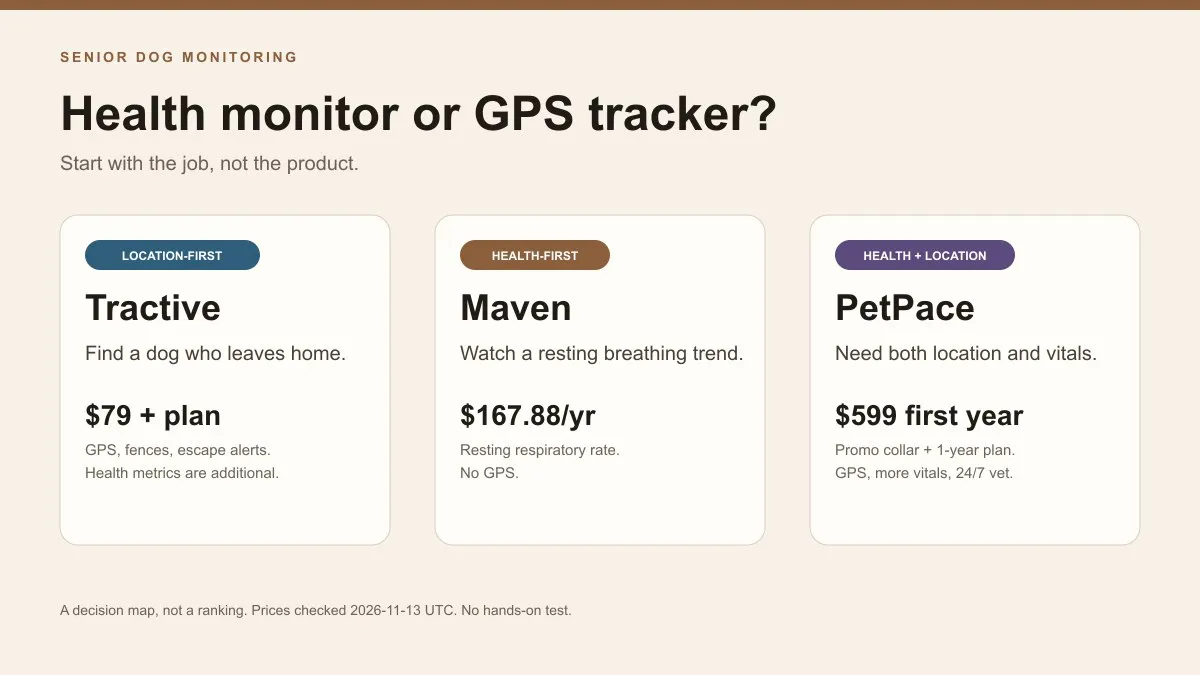
Tractive is location-first, with some health metrics. Maven is health-first, with no location. PetPace is the both option: GPS and Safe Zone, pulse, HRV, temperature, respiration, activity, sleep, posture, calories, and 24/7 vet access. The official PetPace product page I checked showed the collar at $299 after a $100 Holiday Season promotion, down from $399, plus a one-year plan billed at $300, a two-year plan at $400, or a three-year plan at $500. Renewal after the initial term is $200 a year. That puts the first year at about $599 before any renewal.
PetPace costs roughly 3.5 times Maven's first year, and it buys location, more vitals, and vet access. For a dog who stays home and whose main question is a breathing trend, I would be paying for a lot of capability I do not need. For a dog who leaves the house and also has a health condition, the single-device case is stronger. That is a different buyer, and it is why the Maven vs PetPace comparison deserves its own page.
What I will not do is call one category "better." Tractive is built to find a dog; Maven is built to show a trend. Tractive's added health metrics are secondary to that location job, and their accuracy is not established in this evidence set. A combined device is better at being one device. Those are different jobs.
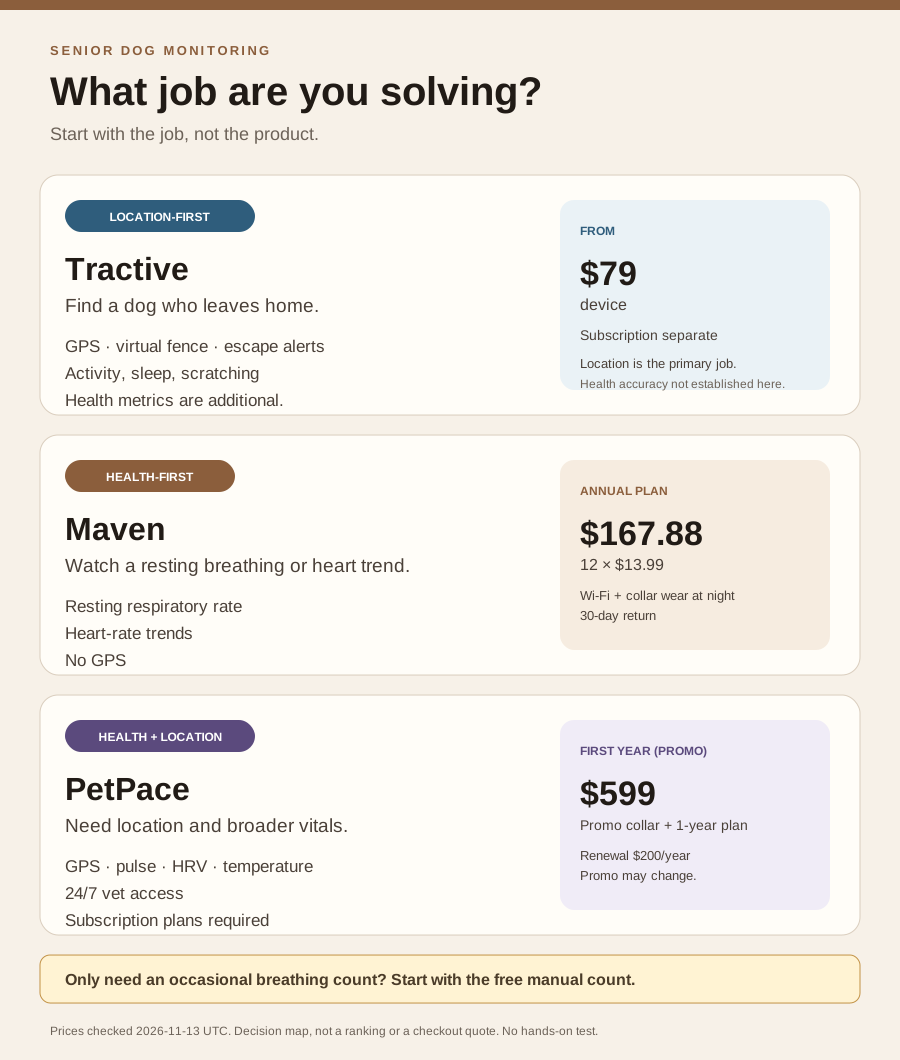
The cost table
These are arithmetic from displayed prices, not checkout quotes.
| Option | First-year cost | Primary job | GPS | Health data | What it does not do |
|---|---|---|---|---|---|
| Maven, annual | $167.88 (12 × $13.99) | Resting breathing and heart trends | No | Resting respiratory rate, heart-rate trends, activity, sleep, scratching, drinking | No GPS, no temperature, not a diagnosis |
| Tractive, Basic 1-year | $187 ($79 + $108) | Location and escape alerts | Yes | Activity, sleep, scratching; page also claims resting heart rate and respiratory rate | Clinical report not verified here; verify plan/tier and accuracy |
| PetPace, 1-year promo | $599 ($299 + $300) | GPS plus multi-vital monitoring | Yes | Pulse, HRV, temperature, respiration, activity, sleep, posture, calories | Not a diagnosis; no head-to-head accuracy study found |
The Tractive number could be $199 if the health features require the Premium one-year plan, which is $120 instead of $108. The PetPace number could rise by $100 when the collar promotion ends. Maven's monthly plan is $150 for the six-month minimum, then $25 a month; it is cheaper than the annual plan only if I stop early, and it carries its own commitment.
Which job wins for which dog
The wanderer with no health condition. GPS-first. A tracker with live location and a virtual fence is the direct answer. Do not buy a health monitor for a dog who bolts.
The heart or chronic-condition dog who stays home. Health-first. The nightly trend is the job the owner cannot do consistently. Maven is the lower-cost example; the free breathing count remains a valid alternative for an owner who will actually keep it.
The dog who does both. A combined device such as PetPace, or two devices, or a tracker plus the free count. The right answer depends on budget and on whether the owner will keep two devices charged and worn. One device that is actually used beats two that are not.
The healthy senior with a disciplined owner. Neither, necessarily. The free count and the breathing-rate tool cover the basics. The subscription buys automation, not access to a secret number.
The dog who will not wear a collar at night. The health monitor's overnight value drops sharply. A tracker may still be useful during the day. Fix the wear problem before buying either.
The dog in respiratory distress. None of these. That is an emergency veterinary visit now. Cornell's Riney Canine Health Center says to take a dog showing signs of respiratory distress to the nearest emergency animal hospital. Do not wait for a device, an alert, or a baseline week.
For my dog, the answer is health-first. The gate is fixed, she stays home, and the murmur is the daily question. I would use the free count first, then decide whether the consistency gap is worth $167.88 a year. If she started escaping again, I would add a tracker rather than ask the health monitor to do a job it does not have.
What to verify before buying
- Which metrics are measured at rest, and which are measured during activity. A respiratory rate collected while the dog is moving is not the same number as a sleeping rate.
- Which plan includes the metrics you want. The Tractive plan grid did not make this clear to me; check before relying on the health side.
- Wi-Fi versus cellular. Maven needs Wi-Fi to sync. Tractive and PetPace use cellular plus GPS. A device that cannot upload is a recorder, not a monitor.
- Battery and wear. A five-to-seven-day battery is a weekly habit. A three-to-four-week battery is easier, but the device still has to stay on the dog.
- The return window and the subscription minimum. Maven's annual plan is a twelve-month commitment; the monthly plan has a six-month minimum. Tractive and PetPace have their own terms.
- What the report is for. A vet-ready trend is different from a live location map. Buy the output you will actually use.
The one rule I would keep: buy the device for the job that happens most often, not the story that scared you most. The gate story was scary. The murmur is daily. For this dog, daily wins.
Maven is an affiliate partner. If you subscribe through the link below, this site may earn a commission at no extra cost to you. The category decision above does not depend on that commission.
Maven partner offer: Track your dog’s wellness. Get $88 off the dog health tracker. Verify the current price at checkout.
[Full Maven Pet review](/posts/maven-pet-review) · [Heart disease and resting breathing rate](/posts/heart-disease-in-senior-dogs)Sources
- Maven dog health tracker, plans and terms: https://maven.pet/dog-health-tracker/
- Maven how it works, metrics, Wi-Fi, baseline, and wear: https://maven.pet/how-it-works/
- Maven home and current offer: https://maven.pet/
- Tractive dog GPS tracker, device price and health features: https://tractive.com/en/pd/gps-tracker-dog
- Tractive US subscription plans: https://tractive.com/en/c/plans?shopCountry=US
- PetPace 3.0 product page, features and plans: https://petpace.com/product/collar-v3/
- 2026 AJVR study, Maven collar agreement with manual counts: https://doi.org/10.2460/ajvr.25.06.0220
- Cornell Riney Canine Health Center, respiratory distress: https://www.vet.cornell.edu/departments-centers-and-institutes/riney-canine-health-center/canine-health-topics/recognizing-and-responding-canine-respiratory-distress