
Splenic Mass in a Senior Dog: Surgery, No Surgery, and How to Decide
By Sarah Bennett · Last updated September 19, 2026 · 13 min read
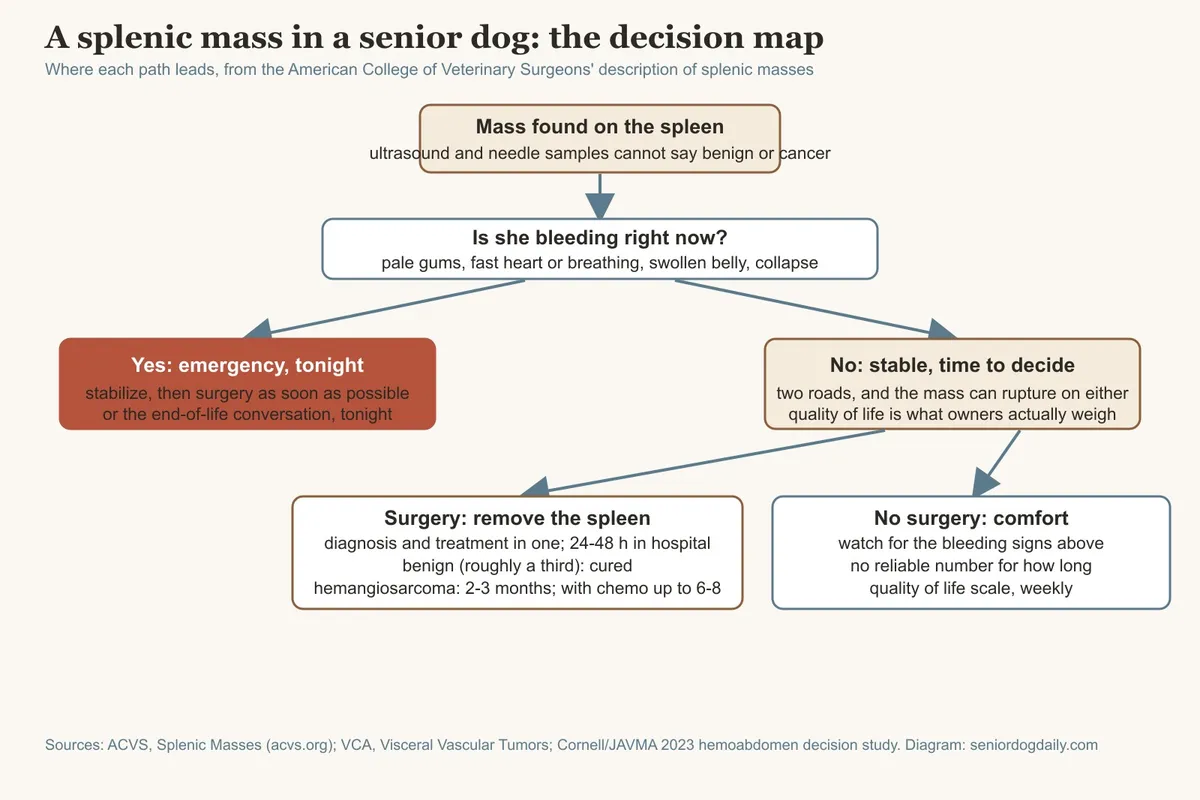
A splenic mass in a senior dog is one of the few diagnoses that asks you to decide before anyone can tell you what it is. The ultrasound shows a mass. The vet cannot say whether it is benign or cancer. The only test that answers that question is the surgery itself, and the surgery is the treatment. So you are choosing between an operation on an old dog, and not operating on a mass that could rupture. This page lays out what is actually known about each road, and then how owners who have stood where you are tend to decide.
The shape of it, in five lines
- Roughly a third of splenic masses are benign, and surgery cures those. Up to two-thirds are cancer, and most of those are hemangiosarcoma.
- Nothing short of removing the spleen tells you which one you have.
- If she is bleeding internally right now, the decision is tonight, not this week.
- If she is stable, there are two roads. Both carry the risk of rupture; only one gives you an answer.
- When researchers asked owners what actually drove the choice, it was the dog's quality of life, not the cost and not the odds.
First: Is She Bleeding Right Now?
Everything else on this page assumes she is stable. Check this before reading on.
A splenic mass can rupture without any injury and bleed into the abdomen. The American College of Veterinary Surgeons lists the signs: "Signs associated with splenic masses can be subtle and include weakness or may be more obvious e.g. collapse and sudden death if the mass ruptures and bleeds internally. Pets may have pale gums, increased heart rate, or increased respiratory rate." A swollen belly, refusing food, and fainting are on the same list.
Lift her lip and look at the gums. Pink is what you want. Pale, white, or grayish gums with a dog who is suddenly weak or who went down and got back up is internal bleeding until proven otherwise, and that is the emergency room, tonight. Our senior dog collapse page covers why a dog who got back up still goes.
If she bled and you are at the emergency clinic, the choice narrows to two: stabilize her and operate as soon as possible, or let her go tonight. ACVS is blunt about the timing: "If the splenic mass has ruptured and is causing internal bleeding, this procedure must be done as soon as possible to prevent further blood loss." The rest of this page is for the harder, slower version, where the mass was found on a scan and she is standing in front of you looking fine.
Why Nobody Can Tell You What It Is
The decision feels impossible for a reason that has nothing to do with your vet being cagey. The two kinds of mass look alike on every test short of a microscope.
ACVS describes the benign end: "Splenic hematoma and nodular hyperplasia are the most common non-cancerous lesions found in the spleen and account for 20–41% of all splenic lesions. They are benign nodules/masses of clotted blood. Surgical removal is curative." And the other end: "Unfortunately, up to two-thirds of dogs with splenic masses have a cancerous mass and most of these masses are an aggressive tumor (hemangiosarcoma)." VCA puts the same split slightly differently: "Up to 70% of dogs with splenic tumors have hemangiosarcoma. The rest (30%) may have a hemangioma or another type of tumor such as lymphoma."
So, roughly: one dog in three has a mass that surgery simply fixes. Two in three have cancer, and most of those have the aggressive one.
Which is your dog? ACVS: "The only way to definitively determine if a splenic mass is non-cancerous or cancerous, is by removal of the spleen and analysis of the tissues under a microscope. Needle aspirate often is unable to determine these." Ultrasound finds the mass and looks for fluid; an echocardiogram may be added because hemangiosarcoma can also sit on the heart; bloodwork and clotting tests prepare for surgery. None of it tells you benign or malignant. The spleen has to come out to know.
That is the whole knot: the surgery is the diagnosis. You cannot get the answer first and then decide.
Road One: Surgery
The operation is a splenectomy, removal of the whole spleen. ACVS explains why the whole organ rather than a biopsy: "Removal of the spleen is preferred to a biopsy as it serves as both a diagnostic and therapeutic procedure". Dogs live without a spleen.
What the days after look like. "Most animals will remain in the hospital for 24–48 hours after surgery to monitor for heartbeat changes and assess their blood volume." Then a large abdominal incision, two weeks of short leash walks only, and a cone or a T-shirt so she cannot get at the site. The complications ACVS lists are "hemorrhage (ongoing bleeding), cardiac arrhythmias (irregular heart rhythm), and pancreatitis (often manifested by vomiting)." The arrhythmias are common enough that an ECG after surgery is standard, and most settle within a day or two.
The senior-specific question is anesthesia, and it is a real question but usually not the one people think. Age by itself is not the risk; the heart, kidneys and liver are, and a pre-anesthetic workup is how the vet finds out where hers stand. Our anesthesia for senior dogs page walks through what raises the risk and what to ask. A stable 12-year-old with clean bloodwork is a different candidate from a 12-year-old in heart failure, and the difference is in the labs, not the birthday.
Then the pathology comes back, and it decides everything after. ACVS, on the two outcomes:
- "Benign splenic masses are effectively cured with surgery." Roughly a third of dogs. They go home, heal, and the mass is over.
- For hemangiosarcoma: "Survival times with surgery alone for dogs with hemangiosarcoma may be two–three months or less. One year survival is less than 10%. Ultimately, dogs die from metastatic disease. Chemotherapy may increase survival times up to six–eight months."
That second one is the number the decision turns on. Published ranges vary by study: ACVS gives two to three months with surgery and six to eight with chemotherapy, and other series report shorter, which is why our cancer overview quotes a lower pair from different sources. Every source agrees on the scale: if it is hemangiosarcoma, surgery alone buys weeks to a few months, and chemotherapy roughly doubles that. It does not buy years. Surgery is worth it in that case for the dog who is bleeding (it stops the bleed and gives you the months), and for the family who wants those months and can tolerate the odds. It is not a cure.
Road Two: No Surgery
Some families decide against operating: the dog is very old, has other serious disease, the anesthesia risk is high, the money is not there, or the one-in-three odds of a cure do not feel worth an operation and a recovery for a dog who is already tired. That is a legitimate road. What it needs is honesty about where it leads.
What you are accepting. The mass stays, and it can rupture. VCA: "Rupture can occur spontaneously, without any traumatic injury, and cause bleeding into the abdomen. Signs of internal bleeding include lethargy, weakness, collapse, decreased appetite, and a distended abdomen." That day may come in a week or in months, and when it comes it is the emergency at the top of this page, with the same two choices, except that she will be weaker and it will be at an hour you did not choose.
How long, without surgery? People search for dog spleen tumor life expectancy without surgery, and in the sources we could verify there is no reliable number. ACVS and VCA give survival figures for dogs who had surgery and turned out to have hemangiosarcoma; neither gives a figure for dogs whose mass was left in place, because those dogs are not followed the same way and because a third of them never had cancer at all. Anyone who gives you a number of days for this road is guessing.
What you can do on this road. Keep her comfortable, keep her weight and appetite in view, and learn the bleeding signs well enough to recognize them at three in the morning. Score her week to week on the quality of life scale, so the decision at the end is made on a trend rather than a bad night. And decide now, while she is stable, what you will do when the bleed comes: surgery then, or goodbye then. Deciding it in the emergency room is the hardest possible place to decide it.
How Owners Decide About a Splenic Mass in a Senior Dog
In 2023, Cornell veterinarians looked at what the university described as "a study of 132 cases seen at the Cornell University Hospital for Animals (CUHA) emergency room", dogs brought in with nontraumatic hemoabdomen, bleeding in the abdomen with no injury to explain it, which is what a ruptured splenic mass looks like from the outside. They wanted to know what drove the owners' choice between surgery, palliative care and euthanasia. The lead oncologist expected money and the odds of cancer to top the list. Instead, as Cornell reported: "we found that quality of life was the primary driver of decision-making among owners".
That matches what owners on the senior-dog forums say when they post from this exact spot. Not "what are the odds," but "what is her life like now, and what would the next two months be like on each road."
So the questions worth answering before the appointment are about her, not about the mass:
- What is her life like this week? Eating, walking, interested, comfortable? Or already at the edge on something else, arthritis she cannot manage, a heart that is failing, dementia that has taken most of her? A dog with a good week ahead of her is a different case from a dog for whom the mass is one more thing.
- What does the anesthesia workup say? Not her age. Her bloodwork, her heart, her kidneys. Ask for the labs before you decide, and read our anesthesia page so you know what they mean.
- If the pathology comes back as hemangiosarcoma, would you do chemotherapy? Decide this before surgery, not after. If the answer is no, then surgery is buying a diagnosis plus two or three months, and the question becomes whether those months are worth the operation and the recovery to her.
- Can your household carry two weeks of recovery? Short leash walks only, an incision to watch, a cone, and a dog who will need help she may not want. If nobody is home, or she cannot be kept quiet, that is a real factor.
- What are the two estimates? Ask for the surgery with histopathology as one number, and chemotherapy as a separate number, so you are not deciding about both at once. Prices vary enough by region and clinic that we do not print them here.
There is no answer on this page to "should I." There are two roads, described as plainly as the sources allow, and five questions that turn "should I" into "what would each road be like for her." Owners who decide on the second version tend to be the ones who do not spend the following year second-guessing it. If you are already on the far side of that decision and the second-guessing has started, our page on guilt after putting your dog down is for that.
Frequently Asked Questions
Spleen tumor surgery or not: how do I decide for an old dog?
Nobody can answer that for you, but the decision has a shape. Surgery is the only way to learn whether it is benign (about a third, cured by surgery) or hemangiosarcoma (most of the rest, two to three months with surgery alone, six to eight with chemotherapy). Not operating means living with the rupture risk and deciding in advance what you will do when it happens. The Cornell study of owners in this position found they decided on the dog's quality of life more than on cost or odds.
Is a splenic mass in a dog benign or malignant, and can the vet tell?
Both are common. ACVS puts benign masses at 20 to 41% of splenic lesions and cancer at up to two-thirds, most of it hemangiosarcoma. No ultrasound, X-ray or needle sample can reliably tell them apart; only removing the spleen and examining the tissue can.
Is my dog too old for a splenectomy?
Age alone is not what surgeons look at. The pre-anesthetic bloodwork, heart and kidney function decide the risk, and a healthy 13-year-old can be a reasonable candidate while a sick 9-year-old is not. Ask for the workup before you decide against surgery on age.
How long can a dog live with a splenic mass without surgery?
There is no reliable published number for this in the sources we could verify, and be wary of anyone who gives you one. About a third of these dogs never had cancer and could live normally for years; the rest carry a mass that can rupture at any time. What can be said is that a rupture is an emergency and that the bleeding signs above are what to watch for.
When to euthanize a dog with hemangiosarcoma?
If she is bleeding internally and surgery is not the road you are taking, the answer is the same night, because the bleed is painful and does not stop on its own. If she is stable after surgery with a hemangiosarcoma diagnosis, the answer is the same as for any terminal illness in an old dog: the quality of life scale, scored weekly, and the conversation in our when to put your dog down guide.
Sources
- American College of Veterinary Surgeons. Splenic Masses. Source of the benign and malignant proportions, the diagnostic limits, the description of surgery and recovery, the survival figures and the complications. Checked 2026-09-19. acvs.org
- VCA Animal Hospitals. Visceral Vascular Tumors. Source of the 70/30 split and the rupture signs. Checked 2026-09-19. vcahospitals.com
- Cornell University College of Veterinary Medicine. Pet's quality of life drives owner decision-making in emergency situations. News report on Menard J, Sylvester S, Lopez D, et al., Journal of the American Veterinary Medical Association, 2023, a study of 132 nontraumatic hemoabdomen cases. Checked 2026-09-19. vet.cornell.edu
Keep Reading
- Senior dog collapse, the emergency version of this page
- Is anesthesia safe for senior dogs, the question that actually decides surgical risk
- Senior dog cancer warning signs, where hemangiosarcoma sits among the others
- Quality of life scale, for either road
Check her gums tonight, and again tomorrow. It takes five seconds and it is the one thing on this page that can change what you do.
About the authors
Sarah Bennett researches senior dog care from a home centered on her Border Collie, Lucy. I am not a veterinarian; every clinical statement on this page is quoted from ACVS, VCA or Cornell and linked at the claim, and the five questions are what owners in this position say they wish they had asked.
Leo Bennett handles the reading and fact-checking behind these pieces, including confirming that the survival figures quoted are for dogs who had surgery, since no source we found gives a figure for dogs who did not.
Sarah and Leo Bennett are pen names. Senior Dog Daily is written and checked by a small editorial team; see About.