
Librela Adverse Events: Every Sign in the FDA's 3,342 Dog Reports (2023-2024 Data)
By Sarah Bennett · Last updated September 17, 2026 · 11 min read
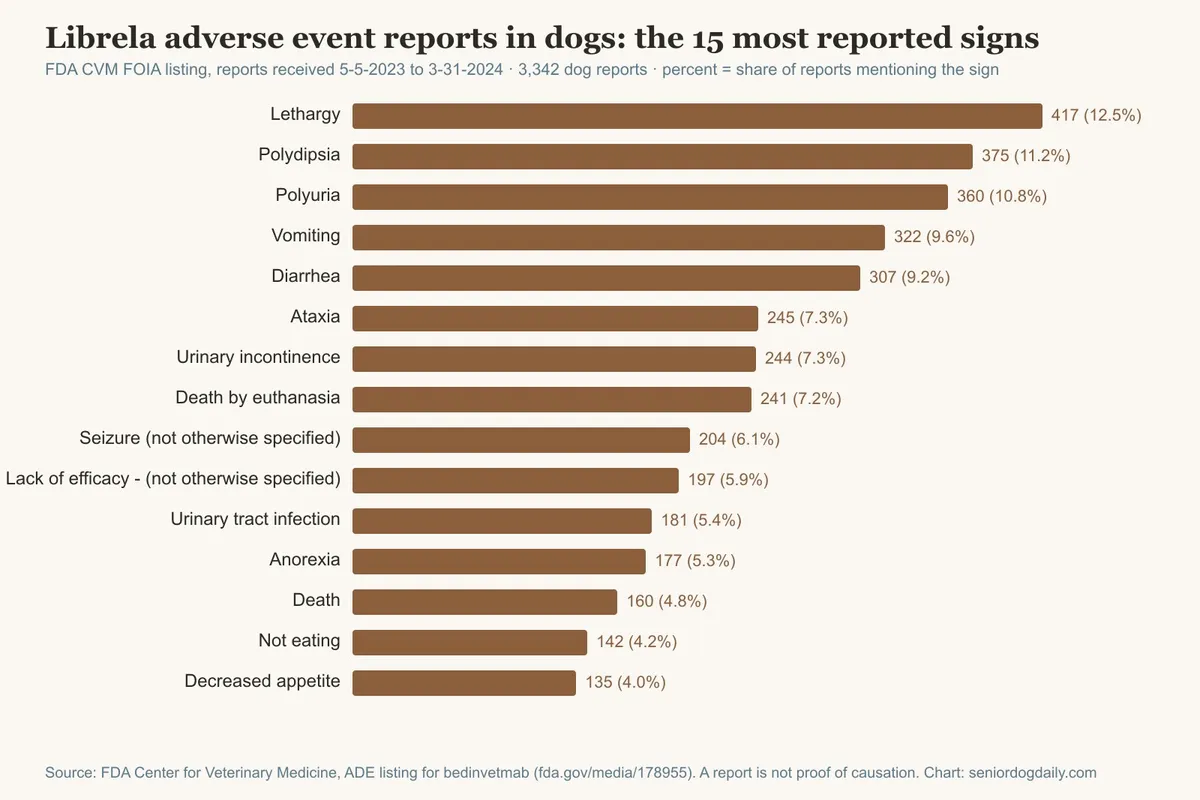
This page is the FDA's own Librela adverse events listing, turned into something you can read: the Librela FDA adverse event reports, sign by sign. Between May 2023 and March 2024 the agency logged 3,342 reports in dogs for bedinvetmab, the antibody in Librela. Those reports name 927 distinct clinical signs, 11,480 sign mentions in all, which is the complete Librela adverse reactions list as the FDA recorded it for that window. We parsed the full document, ranked every sign, grouped them into eleven categories plus a long tail, and put the whole table up for download. Nothing here is estimated; every number below is a count from the FDA file.
How to read this page in one minute
- The listing counts signs, not dogs. One report often carries several signs, so the category totals add up to more than 3,342.
- Percentages are the share of the 3,342 dog reports that mention a sign.
- The categories are ours, assigned by keyword; the FDA lists signs alphabetically without grouping.
- A report is a report. It is not a finding that Librela caused the sign, and the FDA says so in the same document.
- The file has no denominator. How many dogs received Librela in the window is not in it; the manufacturer's global figure is further down.
Download the full table: librela-fda-ade-signs-2023-2024.csv (927 rows: sign, count, percent of reports, category). The FDA's original spellings are preserved in the file.
What This Dataset Is, and Is Not
The document is the FDA Center for Veterinary Medicine's ADE Comprehensive Clinical Detail Report Listing for bedinvetmab, released under a Freedom of Information Act request and printed on April 1, 2024. It covers spontaneous adverse drug event reports received from May 5, 2023 through March 31, 2024. Reports come from veterinarians and owners, directly or through the manufacturer.
Three things the FDA itself says about this kind of data, and that shape everything below:
It cannot establish cause. The listing states plainly: "For any given ADE report, there is no certainty that the reported drug caused the adverse event." A twelve-year-old dog with arthritis is a dog with other things going on, and a report captures what happened after an injection, not what happened because of it.
It cannot be used to compare drugs. The report count depends on how many animals got the drug, how long it has been on the market, and how much attention it is getting. A drug in the news collects more reports.
It has no denominator. The file counts reports; it does not say how many dogs were treated. So a percentage on this page is "share of reports," never "share of dogs on Librela."
Our full discussion of what the signs mean for an individual dog, including the FDA's December 2024 Dear Veterinarian Letter and the manufacturer's response, is in the Librela side effects guide. This page is the data behind it.
The 40 Most Reported Librela Adverse Events
Percent is the share of the 3,342 dog reports that include the sign. Spellings are Americanized for reading; the CSV keeps the FDA's terms.
| # | Sign | Reports | Share of dog reports | Category |
|---|---|---|---|---|
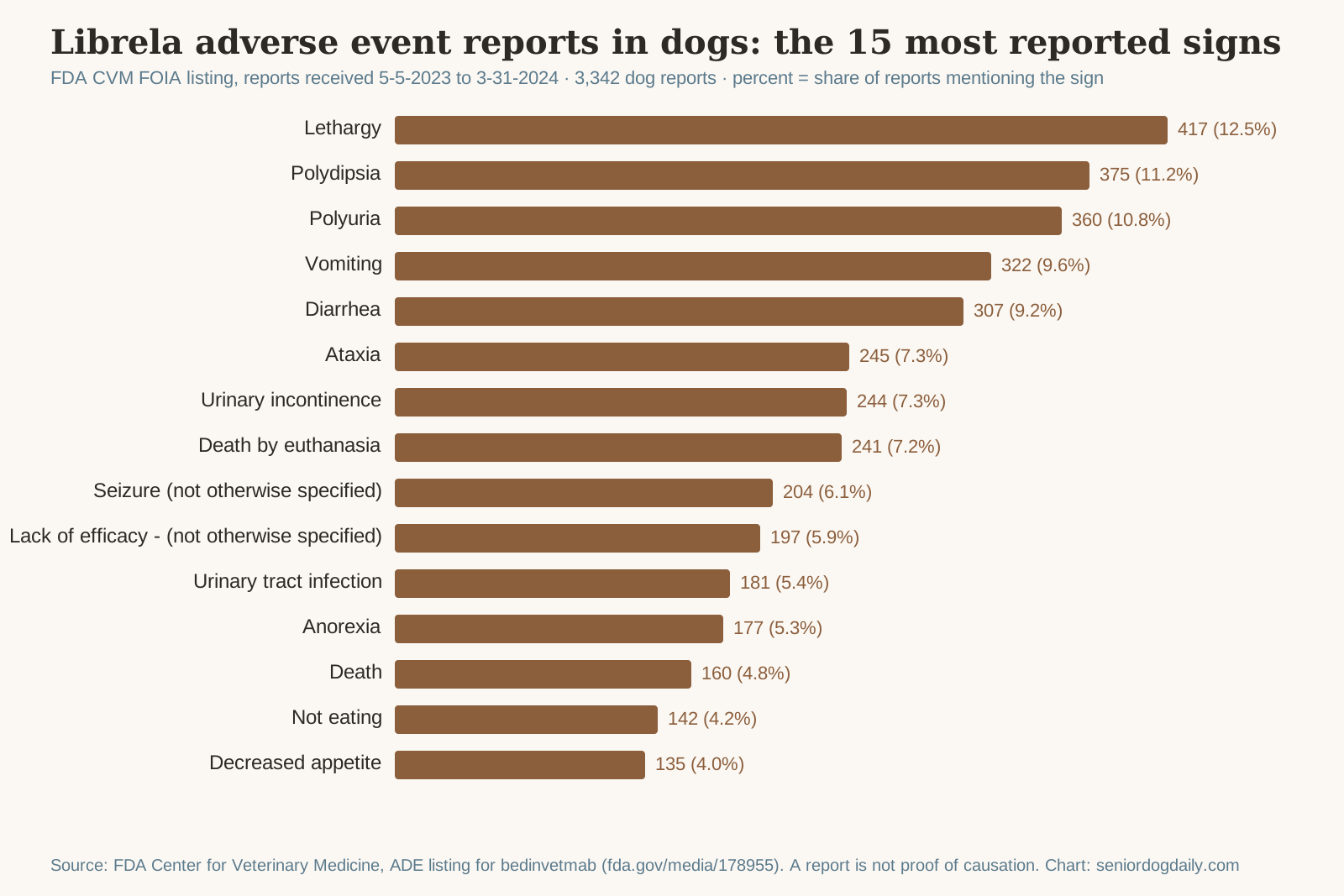
| 1 | Lethargy | 417 | 12.5% | General and systemic |
| 2 | Polydipsia (drinking more) | 375 | 11.2% | Urinary |
| 3 | Polyuria (urinating more) | 360 | 10.8% | Urinary |
| 4 | Vomiting | 322 | 9.6% | Gastrointestinal |
| 5 | Diarrhea | 307 | 9.2% | Gastrointestinal |
| 6 | Ataxia (wobbliness) | 245 | 7.3% | Neurological |
| 7 | Urinary incontinence | 244 | 7.3% | Urinary |
| 8 | Death by euthanasia | 241 | 7.2% | Death |
| 9 | Seizure, not otherwise specified | 204 | 6.1% | Neurological |
| 10 | Lack of efficacy, not otherwise specified | 197 | 5.9% | Lack of efficacy |
| 11 | Urinary tract infection | 181 | 5.4% | Urinary |
| 12 | Anorexia | 177 | 5.3% | Gastrointestinal |
| 13 | Death | 160 | 4.8% | Death |
| 14 | Not eating | 142 | 4.2% | Gastrointestinal |
| 15 | Decreased appetite | 135 | 4.0% | Gastrointestinal |
| 16 | Limb weakness | 135 | 4.0% | Musculoskeletal and mobility |
| 17 | Panting | 135 | 4.0% | Respiratory and cardiac |
| 18 | Partial lack of efficacy | 130 | 3.9% | Lack of efficacy |
| 19 | Inappropriate urination | 120 | 3.6% | Urinary |
| 20 | Hind limb paresis (partial paralysis) | 114 | 3.4% | Neurological |
| 21 | Elevated serum alkaline phosphatase (SAP) | 97 | 2.9% | Laboratory values |
| 22 | Emesis, multiple | 84 | 2.5% | Gastrointestinal |
| 23 | Elevated alanine aminotransferase (ALT) | 82 | 2.5% | Laboratory values |
| 24 | Proprioception deficit | 82 | 2.5% | Neurological |
| 25 | Unable to walk | 81 | 2.4% | Musculoskeletal and mobility |
| 26 | Elevated blood urea nitrogen (BUN) | 79 | 2.4% | Laboratory values |
| 27 | Unable to stand | 79 | 2.4% | Musculoskeletal and mobility |
| 28 | Weight loss | 79 | 2.4% | General and systemic |
| 29 | Decreased urine concentration | 78 | 2.3% | Laboratory values |
| 30 | Weakness | 72 | 2.2% | Musculoskeletal and mobility |
| 31 | Lameness | 70 | 2.1% | Musculoskeletal and mobility |
| 32 | Vocalization | 66 | 2.0% | Behavioral |
| 33 | Pain, not otherwise specified | 63 | 1.9% | Musculoskeletal and mobility |
| 34 | Behavioral disorder, not otherwise specified | 58 | 1.7% | Behavioral |
| 35 | Hind limb ataxia | 58 | 1.7% | Neurological |
| 36 | Not himself/herself | 57 | 1.7% | Behavioral |
| 37 | Walking difficulty | 57 | 1.7% | Musculoskeletal and mobility |
| 38 | Fecal incontinence | 56 | 1.7% | Gastrointestinal |
| 39 | Fever | 55 | 1.6% | General and systemic |
| 40 | Inappetence | 54 | 1.6% | Gastrointestinal |
The remaining 887 signs each appear in 53 or fewer reports; 740 of them appear ten times or fewer, and 285 appear exactly once. The full list is in the download.
The Signs Grouped Into Categories
Sign mentions, not dogs. A report with vomiting and diarrhea contributes two mentions to Gastrointestinal.
| Category | Sign mentions | Share of all mentions | Distinct signs |
|---|---|---|---|
| Urinary | 1,757 | 15.3% | 47 |
| Gastrointestinal | 1,652 | 14.4% | 56 |
| Neurological | 1,442 | 12.6% | 76 |
| Laboratory values | 1,268 | 11.0% | 72 |
| Musculoskeletal and mobility | 1,118 | 9.7% | 64 |
| Other | 1,032 | 9.0% | 370 |
| General and systemic | 916 | 8.0% | 50 |
| Skin and injection site | 589 | 5.1% | 106 |
| Behavioral | 546 | 4.8% | 31 |
| Respiratory and cardiac | 420 | 3.7% | 46 |
| Death | 412 | 3.6% | 6 |
| Lack of efficacy | 328 | 2.9% | 3 |
"Other" is the long tail: 370 signs that did not fit a category cleanly, almost all reported fewer than ten times. The category rules are in the parsing script linked at the bottom, so anyone can rerun them differently.
Four Things the Librela Adverse Events Data Shows
1. The everyday signs lead. Lethargy, drinking more, urinating more, vomiting and diarrhea are the top five, and between them they account for about 15 percent of all sign mentions. They are also the signs the label already lists. Nothing in the top five is a surprise to the manufacturer or the FDA.
2. The urinary cluster is larger than it looks in any single row. Polydipsia, polyuria, urinary incontinence, urinary tract infection and inappropriate urination together appear 1,280 times. Because these often travel together in one report, that is not 1,280 dogs, but it is the largest coherent group in the file, and incontinence in an old dog is the one most easily written off as age. Our side effects guide covers what to watch for after a first injection.
3. The Librela neurological side effects are a real and sizable cluster. Ataxia, seizures, limb weakness, hind limb paresis, proprioception deficit, being unable to walk or stand, and hind limb ataxia sum to 998 mentions, and those are only the eight largest neurological rows out of 76. This is the group the FDA named in its Dear Veterinarian Letter, and the group with the least overlap with ordinary arthritis. A dog who was stiff and is now wobbly has changed category. The home check in our weak back legs guide is how to tell the two apart.
4. Death appears in the file 401 times. "Death by euthanasia" 241 times and "Death" 160 times. Because a report can carry more than one sign, 401 is an upper bound on the number of reports involving a death, and it says nothing about whether the drug was the reason. Most dogs on Librela are old, many have other diseases, and euthanasia is how most old dogs die regardless of what they were taking. What the number does say is that a death was recorded in up to 12% of the reports the FDA received in this window. That is a number worth knowing before an injection, and worth putting next to the denominator below.
The Denominator the FDA Does Not Have
The manufacturer does. Zoetis published its global pharmacovigilance data in Frontiers in Veterinary Science in April 2025, covering February 2021 through June 2024. In that period 18,102,535 doses were sold worldwide, with 17,162 adverse events reported in dogs, which the authors put at 9.48 events per 10,000 doses.
Two cautions on putting the two datasets side by side. The Zoetis figure is global and spans three and a half years; the FDA file is United States only and spans eleven months, so they are not the same population. And the Zoetis paper was written by the company that sells the drug, which does not make it wrong, but does make it worth reading alongside the independent analysis of musculoskeletal events by Farrell and colleagues in the same journal, which is discussed in our side effects guide.
Read together, the honest summary is: a low absolute rate of reported events per dose, and within the reports that do arrive, a recognizable pattern of urinary, gastrointestinal and neurological signs in a population of old dogs.
How to Use This Before or After an Injection
- Before: ask the vet which of the top categories your dog is already at risk for. A dog with kidney values on the edge, or a history of seizures, is a different conversation from a dog with none of that. Our Librela guide covers what the drug does and who it suits.
- After: the signs to watch in the first weeks are the ones in the table, and the ones that change the picture are the neurological ones: wobbliness, knuckling, a back end that buckles, a seizure. Those are same-day calls.
- If something happens: report it. To the vet, who reports to Zoetis and the FDA, or directly to the FDA. The 3,342 reports on this page exist because people did.
- If you are weighing alternatives: the Librela alternatives guide sets the other options next to it, and Adequan is the other injectable.
Frequently Asked Questions
How many adverse event reports has the FDA received for Librela?
In the FOIA release covering May 5, 2023 through March 31, 2024, the FDA lists 3,342 reports in dogs, plus one in a cat and 16 human accidental exposures. Reports received after March 2024 are not in this file. The FDA continues to receive them, and a later request would produce a larger number.
How many dogs have died from Librela?
The file cannot answer that, and neither can this page. It records 241 mentions of "death by euthanasia" and 160 of "death," so up to 401 of the 3,342 reports involve a death. It does not record whether Librela caused any of them, and the FDA states that no report on its own establishes cause. Librela is given to old dogs, and old dogs die of many things.
What are the most common Librela adverse events?
By report count: lethargy (417), increased drinking (375), increased urination (360), vomiting (322), and diarrhea (307). Each appears in roughly 9 to 12 percent of the reports. Those five are also on the product label.
Are the neurological side effects of Librela common?
Common in the reports, unknown in the treated population. Ataxia alone appears in 7.3% of reports and seizures in 6.1%, and the neurological category holds 1,442 mentions across 76 signs. Without knowing how many dogs were treated in the same window, the file cannot turn that into a rate per dog. The manufacturer's global figure for all adverse events is 9.48 per 10,000 doses.
Where does this data come from, and can I check it?
From the FDA Center for Veterinary Medicine's adverse drug event listing for bedinvetmab, released under FOIA and linked in the sources; if you search for Librela FOIA data, that document is what you will find. The document is public. Our parsing script and category rules are downloadable below, and the CSV above reproduces every count in the file.
Sources
- U.S. Food and Drug Administration, Center for Veterinary Medicine. CVM ADE Comprehensive Clinical Detail Report Listing, bedinvetmab. FOIA response dated April 1, 2024, covering reports received May 5, 2023 through March 31, 2024. Source of every count on this page. fda.gov/media/178955
- U.S. Food and Drug Administration, Center for Veterinary Medicine. ADE listing cover notes. Source of the causation caveat quoted above. fda.gov/media/186109
- Zoetis pharmacovigilance data, Frontiers in Veterinary Science, April 2025. Source of the doses-sold and events-per-10,000 figures. frontiersin.org
- Parsing script and category rules: build-librela-ade-data.mjs. Rerun it against a newer FOIA release to update this page.
Keep Reading
- Librela side effects in dogs, what each sign means for an individual dog
- Librela for dogs: does it work, the drug, the cost, and who it suits
- Librela alternatives, if the table above changed your mind
- Old dog back legs weak or giving out, the home check that separates pain from nerve signs
If you find an error in the table, write to us. The counts are only as good as the parsing, and the file is public for anyone to check.
About the authors
Sarah Bennett researches senior dog care from a home centered on her Border Collie, Lucy. I am not a veterinarian; every count on this page comes from the FDA document linked at the claim, and the interpretation is labeled as ours.
Leo Bennett handles the reading and fact-checking behind these pieces, including rerunning the parser against the source PDF and checking the category totals against the sign counts.
Sarah and Leo Bennett are pen names. Senior Dog Daily is written and checked by a small editorial team; see About.